Exercise list · Calves
Best Calf Exercises
Seven moves, ranked, and how to program them so your calves actually grow.
Calves are hard to grow and easy to neglect. These seven exercises cover both calf muscles, with or without a machine.

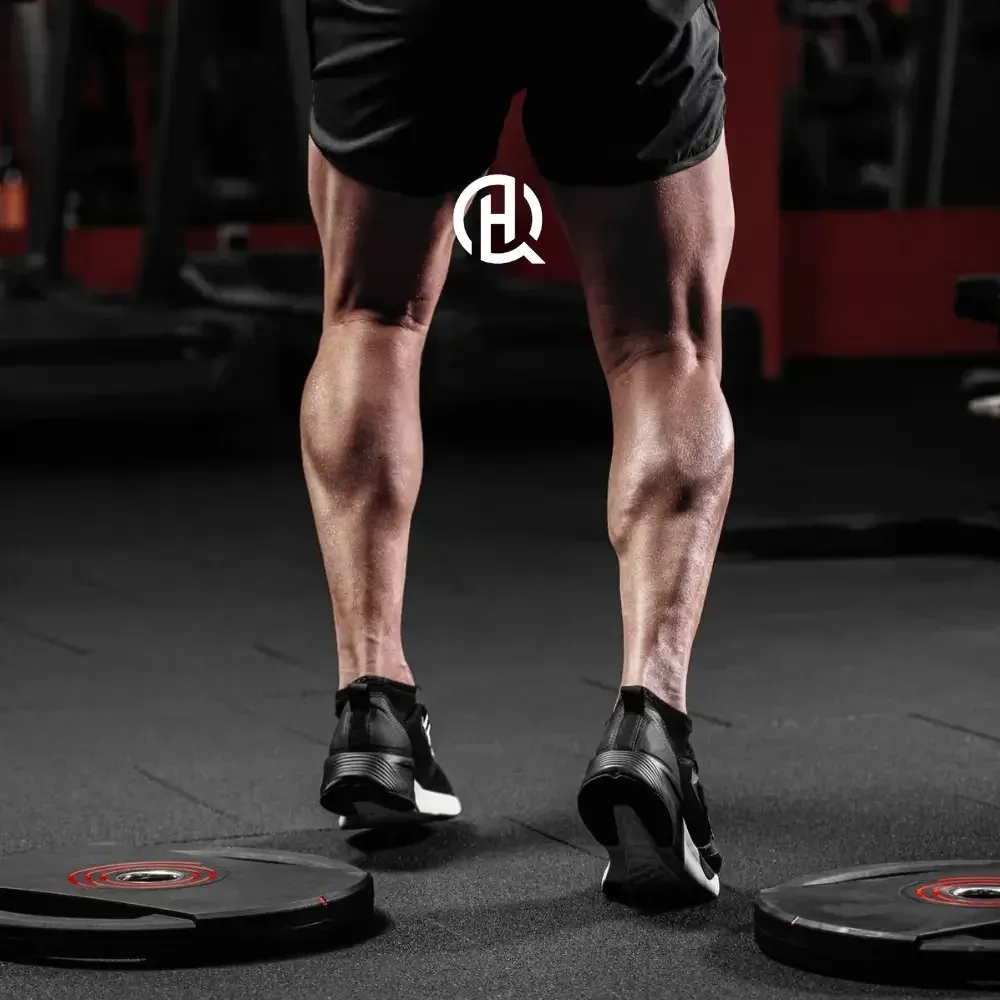
The best calf exercises are the standing calf raise for the gastrocnemius, the seated calf raise for the soleus, and the single-leg calf raise when you have no machine. Train calves two to three times a week, through a full range of motion, with a pause in the stretch, and mix straight-knee and bent-knee raises.
Key takeaways
- Straight-knee raises train the gastrocnemius; bent-knee raises train the soleus. Do both.
- Full range beats heavy weight: deep stretch, full squeeze, no bouncing.
- 2–3 sessions a week of 3–4 hard sets each is enough for most people.
- Most calf work lands in the 8–20 rep range, lowered in 2–3 seconds.
- No machine? Single-leg raises on a step with a dumbbell work well.
- Fighters need strong and springy calves: loaded raises for push-off, rope or hops for rhythm on your toes.
- Muscles
- Gastrocnemius, soleus
- Equipment
- Step, dumbbells, calf machines, leg press
- Difficulty
- Beginner
- Sets & reps
- 3–4 × 8–20, 2–3 times a week
Quick list
The 7 best calf exercises at a glance
| Exercise | Main target | Equipment | Best for | Sets × reps |
|---|---|---|---|---|
| 1. Standing calf raise | Gastrocnemius | Calf machine, Smith machine or step | Calf size | 3–4 × 8–15 |
| 2. Seated calf raise | Soleus | Seated calf machine or bench + dumbbells | Lower-calf thickness | 3–4 × 10–20 |
| 3. Single-leg calf raise | Gastrocnemius | Step + dumbbell | No machine; evening out sides | 3 × 10–15 per leg |
| 4. Donkey calf raise | Gastrocnemius | Bench or donkey machine | Deep stretch | 3 × 10–15 |
| 5. Leg press calf raise | Gastrocnemius | Leg press | Heavy load, no spinal load | 3 × 10–15 |
| 6. Seat-to-stand calf raise | Both | Bench | Light, high-rep work | 2–3 × 12–20 |
| 7. Jump rope | Gastrocnemius | Rope | Conditioning and springy calves | 3–5 rounds of 30–60 s |
Scroll the table sideways to see every column.
Ranked for building calf muscle. Sets and reps are general starting ranges.
Anatomy
Calf anatomy: gastrocnemius vs soleus
Gastrocnemius
The two-headed muscle that forms most of the visible bulk of your calf. It crosses both the knee and the ankle, so it works hardest when your knees are straight.
Soleus
Wide and flat, under the gastrocnemius. It crosses only the ankle, so it takes over when your knees are bent. It helps with walking, running and standing posture.
Achilles tendon
Both muscles join above the heel to form it. It carries the force from your calves to your foot.
This is why you need straight-knee and bent-knee exercises.
The ranking
The 7 best calf exercises, ranked
-
01
Best for: calf size
Standing calf raise
The main exercise for the gastrocnemius and for calf size. Loading: machine, Smith machine, dumbbells at your sides or a barbell on your back.
Key cue Balls of the feet on a platform, heels below your toes at the bottom. Knees straight. One-second hold at the top.
Sets & reps: 3–4 × 8–15.
How to do the standing calf raise -
02
Best for: lower-calf thickness
Seated calf raise
Bent knees put the soleus in charge. It builds thickness low on the calf that standing raises miss. No machine: sit on a bench with a dumbbell on each knee and your toes on a plate.
Key cue Pad just above the knees. Full stretch. Lower in two to three seconds.
Sets & reps: 3–4 × 10–20.
How to do the seated calf raise -
03
Best for: training without a machine and evening out sides
Single-leg calf raise
A standing raise one leg at a time, holding a dumbbell on the same side as the working leg. It doubles the load on each calf without a machine and shows if one side is weaker.
Key cue Hold a wall or rail for balance.
Sets & reps: 3 × 10–15 per leg, weaker side first.
-
04
Best for: a deep stretch
Donkey calf raise
Hinge at the hips to about a right angle, hands on a bench, and raise your heels from a step. The hip bend stretches the gastrocnemius from the top, which gives a deep stretch at the bottom of each rep. Add load with a donkey machine, a weight belt, or a partner.
Key cue Toes straight for most sets. Small changes in toe angle are fine for variety, but don't let your ankles roll.
Sets & reps: 3 × 10–15.
-
05
Best for: heavy load with no spinal load
Leg press calf raise
On the leg press, put only the balls of your feet on the bottom edge of the platform, legs nearly straight, and press with your ankles. It loads the calves heavily with your back supported.
Key cue Keep a slight knee bend, and if your machine has adjustable stops, set them just below your working range so the sled can't slide down if your feet slip.
Sets & reps: 3 × 10–15.
How to do the leg press -
06
Best for: light, high-rep work
Seat-to-stand calf raise
Sit on a bench, raise your heels, then stand up and finish on your toes; lower and sit back down each rep. It trains both calf muscles with a light load.
Key cue Fast reps are more dynamic, slow reps add tension.
Sets & reps: 2–3 × 12–20.
-
07
Best for: conditioning and springy calves
Jump rope
Quick, springy contacts work the calves and the Achilles tendon, and build conditioning. It is not a main size builder; use it as a warm-up or finisher. Variations: single-leg, high-knee, double-unders.
Key cue Elbows close, slight knee bend, land on the balls of your feet.
Sets: 3–5 rounds of 30–60 seconds.
Stubborn calves
Why are calves so hard to grow?
Three reasons, and you control two of them.
- 01
They're used to work
Your calves carry you all day. A few easy sets don't ask them for anything new.
- 02
They're usually trained badly
Last exercise of leg day, a few bouncy half reps, done. Calves need full range, control and hard sets like any other muscle.
- 03
People differ
Some people grow calves faster than others, and you can't change your starting point. You can change how you train them.
"Calves don't care how heavy the stack is. They respond to range, control and frequency. Get those three right before you add weight."
Herman Leir, Personal Trainer
Programming
How to train calves: sets, reps and frequency
- 01
Frequency
2–3 sessions a week. Calves recover fast.
- 02
Volume
3–4 hard sets per session, 6–12 hard sets a week to start.
- 03
Reps and tempo
8–20 reps. Two to three seconds down, a pause in the stretch, one second at the top.
- 04
Mix knee angles
At least one straight-knee and one bent-knee exercise each week.
Progress by adding reps first, then load. If your reps get shorter, the weight is too heavy. Not sure how much to train overall? See how much you should train.
Put it together
A simple calf workout
| Exercise | Sets × reps | Tempo / note |
|---|---|---|
| Standing calf raise | 3 × 8–12 | 2–3 s down, 1 s hold at top |
| Seated calf raise | 3 × 12–20 | Pause 1–2 s in the stretch |
| Single-leg calf raise | 2 × max controlled reps per leg | Weaker leg first |
Do it at the end of leg day or on an upper-body day, twice a week. For a full lower-body session, see the leg day workout.
For fighters
Calf exercises for fighters
If you box, kickbox or train Muay Thai or MMA, your calves run your footwork. They keep you light on the balls of your feet for whole rounds, push you off into every step, slip and pivot, and act like springs with the Achilles tendon when you bounce. That takes two things: strength to push off hard, and stiffness and endurance to keep bouncing without your feet going flat.
Train both. Single-leg standing raises build push-off strength one side at a time, the way you step in your stance. Seated raises with high reps build the endurance for staying on your toes. Calves recover fast, but heavy, slow lowering still leaves them sore. More in strength and conditioning for fighters.
When
Do loaded raises at the end of a lifting day or after an easy skill session, not before hard sparring.
How much
Two or three sets per move, stopping 1–3 reps short of failure, is enough. Cut the volume in the last weeks before a fight.
Springy contacts
Jump rope or low pogo hops train the quick, springy contacts.
Questions
Best calf exercises: FAQ
How often should you train calves?
Two to three times a week works for most people. Calves recover quickly, so they handle frequent training better than most muscles. Aim for three or four hard sets per session, with at least one straight-knee exercise like the standing calf raise and one bent-knee exercise like the seated calf raise across the week.
Are seated or standing calf raises better?
You need both. Standing calf raises keep your knees straight, so the gastrocnemius, the big upper calf muscle, does most of the work. Seated calf raises bend your knees, which slackens the gastrocnemius and makes the soleus underneath do the lifting. Training only one leaves part of your calf undertrained.
How many reps should you do for calves?
Most calf training works well between 8 and 20 reps per set. Heavier sets of 8–12 suit standing raises; 12–20 suits seated raises and single-leg work. The number matters less than the quality: a full stretch at the bottom, a full squeeze at the top, and a slow two-to-three-second lowering on every rep.
Can you grow calves without a gym?
Yes. Single-leg calf raises on a step, holding a dumbbell or a loaded backpack, are hard enough to grow most people's calves. Add seated raises with a weight on your knees for the soleus. Use slow reps, pause in the stretch and train them often. Jump rope helps conditioning but is not enough on its own.
Why won't my calves grow?
Usually because they're trained last, with short bouncy reps and too few hard sets. Use a full range of motion, pause in the stretch, train them two to three times a week and add reps or load over time. Some people grow calves slower than others. Give a consistent plan at least a few months before you judge it.
Does jump rope build calves?
Jump rope works your calves and builds conditioning, but on its own it is not the best size builder. The loads are light and each contact is short. Use it as a warm-up or finisher, and get most of your calf growth from loaded raises like the standing, seated and single-leg calf raise through a full range of motion.
Are calf exercises good for boxing and Muay Thai?
Yes. Your calves keep you on the balls of your feet and push you off into every step and pivot. Use single-leg standing raises for push-off strength, high-rep seated raises for endurance, and jump rope for quick, light contacts. Two or three sets per move is enough. Do the loaded raises after lifting or an easy session, not right before hard sparring.
Calves Focused
Stop guessing with your calves.
The Calves Focused program is part of the HermQ bodybuilding subscription, which unlocks every bodybuilding program while it is active.
60-day money-back guarantee.
Want lower legs built for footwork? Combat Performance is HermQ's combat program, $29 once.
Get Instant Access – $29