Exercise guide
Close-Grip Lat Pulldown
V-bar setup, form cues and how it compares to the wide grip.
The close-grip lat pulldown swaps the long bar for a V-handle. Here is how to do it, what it trains, and when to pick it over the wide grip.

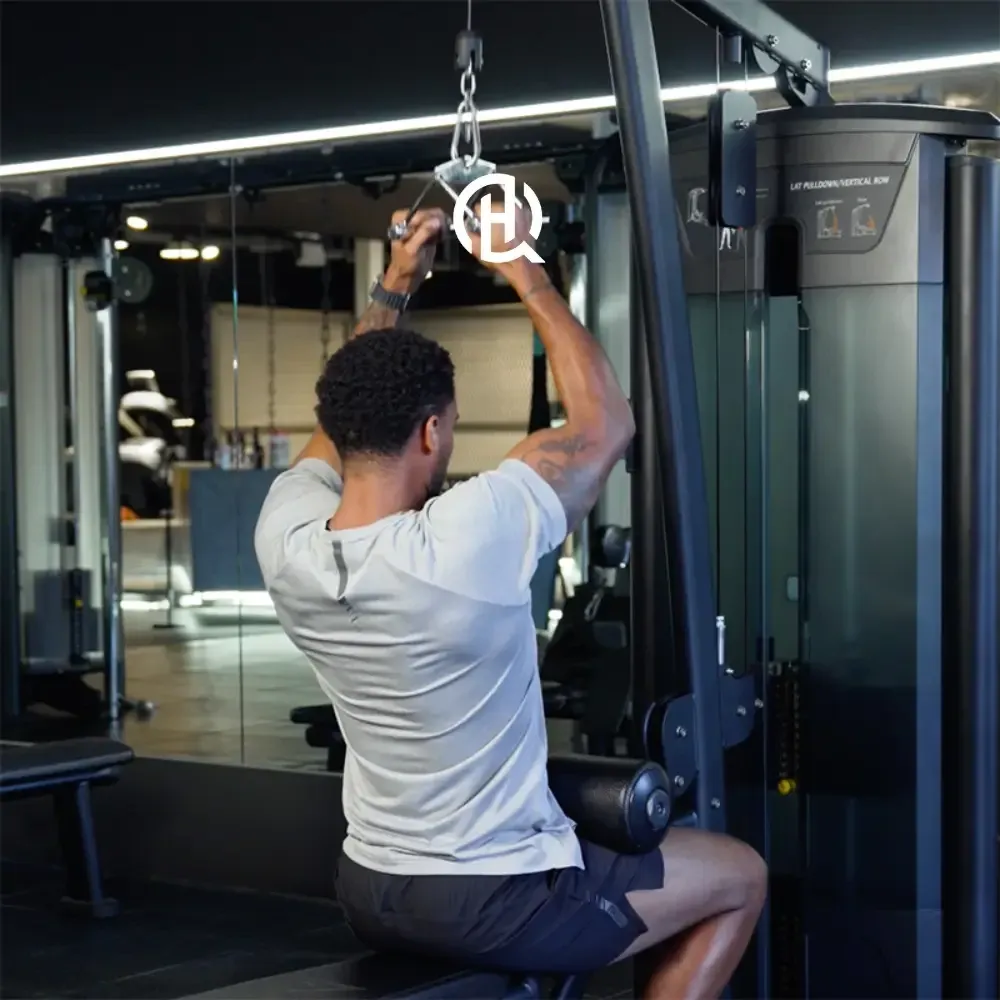 Watch the demo
The close-grip lat pulldown is a cable pulldown done with a V-bar, palms facing each other, pulled to your upper chest. The narrow neutral grip lets your elbows travel close to your body through a long range of motion. It trains the lats hard, with more biceps help than the wide grip, and many lifters find it easy to feel.
Key takeaways
- Use a V-bar (double-D handle) with palms facing each other.
- Lean back slightly and pull the handle to your upper chest, elbows close to your sides.
- It gives a longer range of motion and more biceps help than the wide grip. Both train the lats well.
- Control the handle up for two to three seconds, all the way to straight arms.
- Use it alongside, or instead of, the wide grip. 3–4 sets of 8–12 reps suits most people.
- Muscles
- Lats (main), teres major, biceps, brachialis, mid-back, rear delts
- Equipment
- Lat pulldown machine, V-bar handle
- Difficulty
- Beginner
- Sets & reps
- 3–4 × 8–12, 60–90 s rest
Step by step
How to do the close-grip lat pulldown
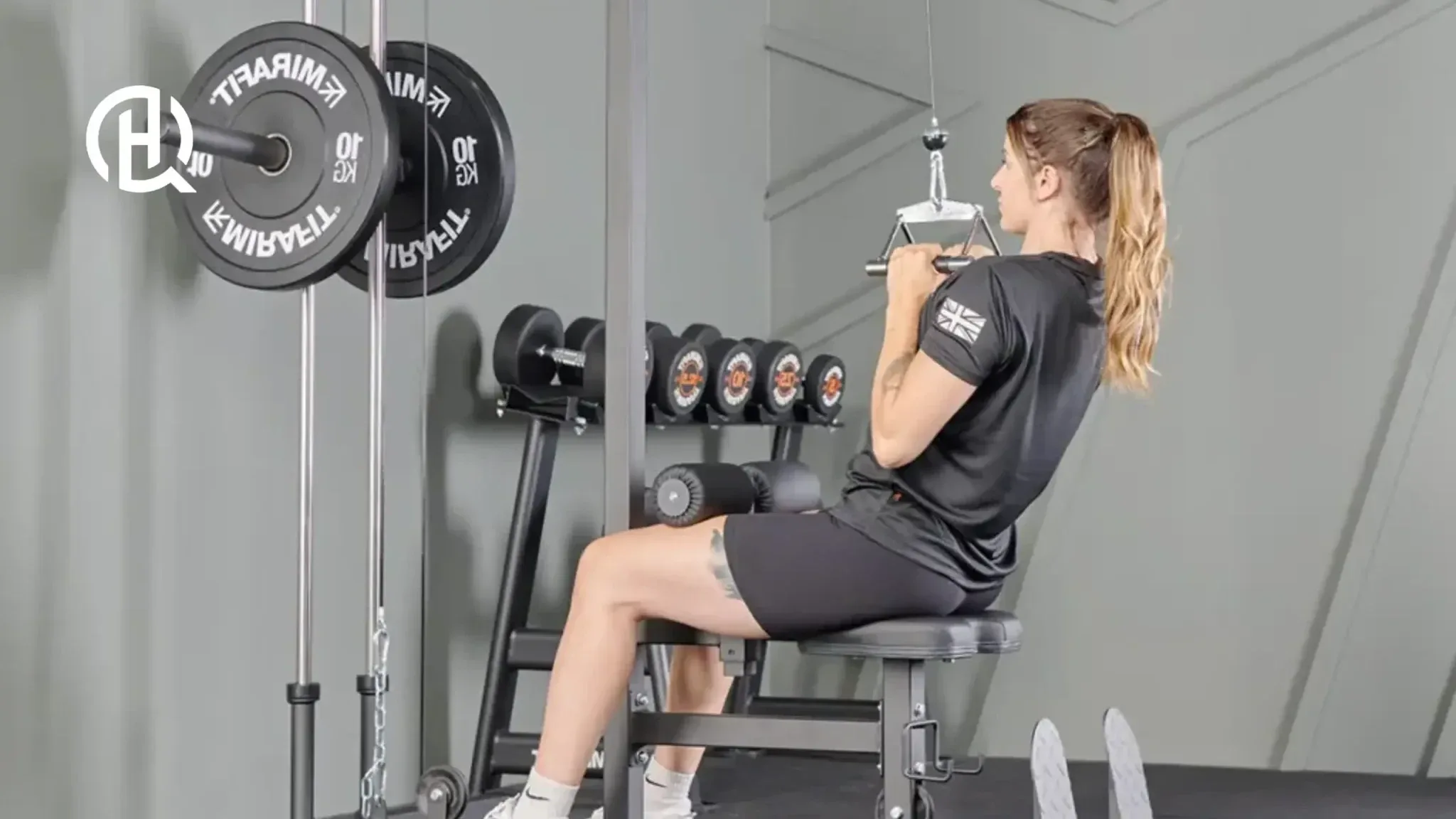
- 01
Attach a V-bar
Clip the V-handle to the high pulley. Set the thigh pad so your thighs are locked in.
- 02
Grip
Stand, grab both handles with palms facing each other, then sit down with your arms straight overhead.
- 03
Set up
Chest up, slight lean back of about 15–30 degrees, core tight, feet flat.
- 04
Shoulder blades first
Pull them down and slightly back before your elbows bend.
- 05
Pull
Drive your elbows down and close to your sides until the handle reaches your upper chest. Pause for a second.
- 06
Return slowly
Let the handle rise over two to three seconds until your arms are fully straight and your lats are stretched.
For a one-screen version, use the close-grip pulldown exercise card.
Get it right
Form cues
- 01
Elbows to hips
Think about driving your elbows into your back pockets.
- 02
Stop at the chest
The handle meets your upper chest. Pulling lower turns it into an arm exercise.
- 03
Same angle all set
Pick your lean and keep it. No rocking.
- 04
Full stretch
Arms straight and shoulders reaching up at the top of every rep.
To make light weights harder, hold the bottom position for 2–3 seconds on each rep.
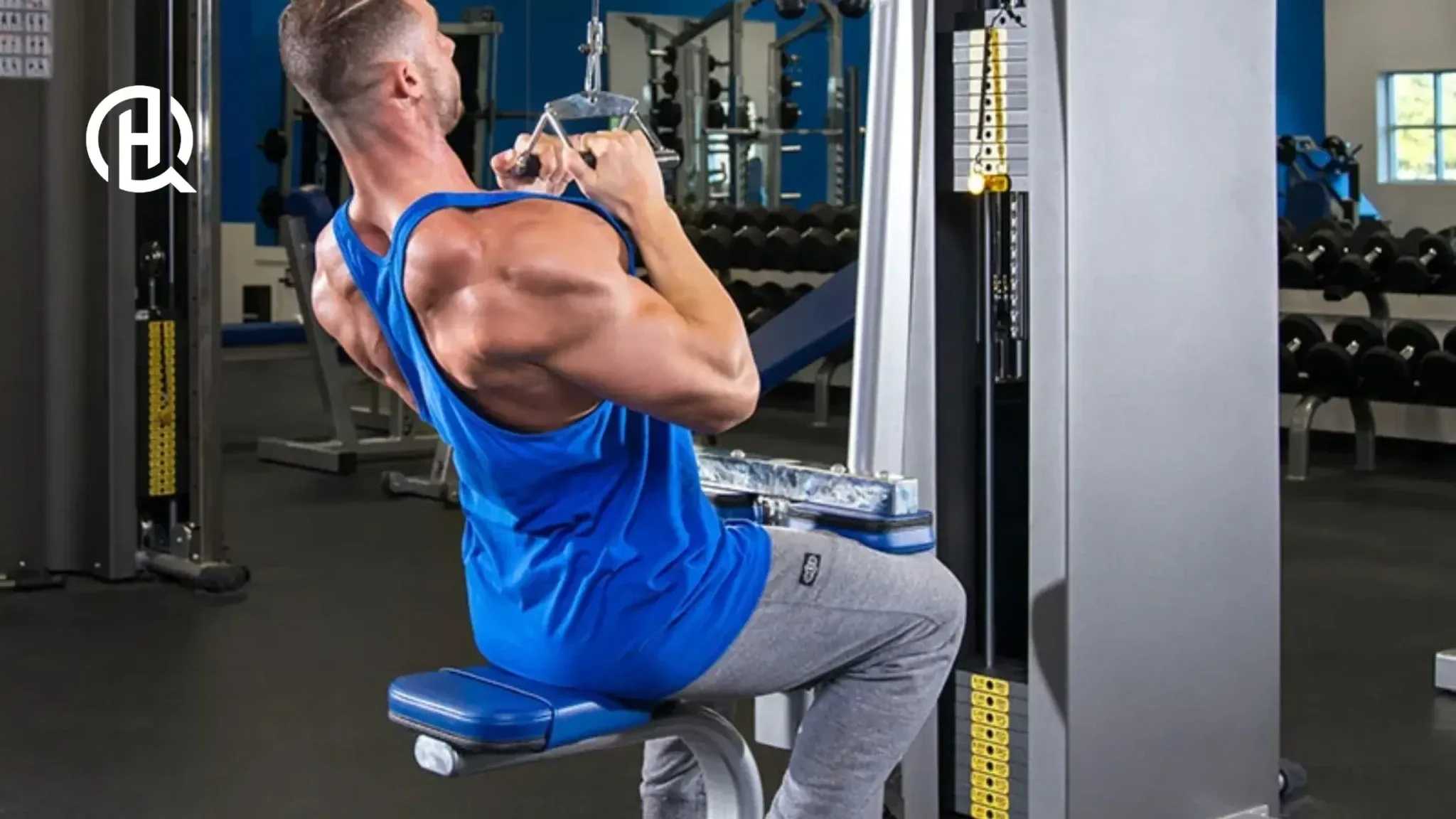
Anatomy
Muscles worked in the close-grip lat pulldown
| Muscle | Role |
|---|---|
| Latissimus dorsi | Main mover. Pulls the upper arm down and back to your side. |
| Teres major | Helps the lats near the armpit. |
| Biceps, brachialis | Bend the elbow. The neutral grip brings in more brachialis. |
| Rhomboids, mid and lower traps | Pull the shoulder blades down and together. |
| Rear delts | Help pull the arm back. |
Compare
Close-grip vs wide-grip lat pulldown
Both are good lat exercises. They differ in grip, range of motion and how much your arms help.
| Feature | Close grip (V-bar) | Wide grip (long bar) |
|---|---|---|
| Grip | Neutral, palms facing, hands close | Overhand, about 1.5× shoulder width |
| Elbow path | Close to your sides, in front of the body | Out to the sides |
| Range of motion | Longer | Shorter |
| Biceps help | More | Less |
| Lean back | A little more (15–30°) | Slight (10–20°) |
| Carries over to | Neutral-grip pull-ups, chin-ups | Standard pull-ups |
Which should you use?
If you have one back day, pick the one you feel most in your lats and progress it. If you train back twice a week, use the wide grip one day and the close grip the other. For the full wide-grip technique, see the wide-grip lat pulldown guide.
"I like the close grip as the second pulldown in a session, when the shoulders are warm and you can use the full stretch."
Herman Leir, Personal Trainer
What to avoid
Common close-grip pulldown mistakes
- 01
Pulling past chest level
The handle drops to your stomach and your arms take over. Stop at the upper chest.
- 02
Using momentum
Rocking back to start the rep. Lower the weight until your torso stays still.
- 03
Going too heavy
If you can't reach straight arms at the top and your chest at the bottom, it's too heavy.
- 04
Rushing the way up
Letting the handle snap back skips the stretch. Two to three seconds up.
- 05
Leaning back too far
Past about 30 degrees it becomes a row. If that's what you want, do a seated cable row instead.
Programming
Sets and reps by goal
| Goal | Sets × reps | Rest |
|---|---|---|
| Muscle size | 3–4 × 8–12 | 60–90 s |
| Strength | 3–5 × 6–8 | 2 min |
| Technique, warm-up | 2 × 12–15, light | 60 s |
When every set reaches the top of the range with clean form, add one plate step.
Swap options
Variations and alternatives
Wide-grip lat pulldown
The standard version.
Reverse-grip lat pulldown
Underhand straight bar at shoulder width. Closer to a chin-up. Not the same as this V-bar version. See the reverse-grip lat pulldown.
Neutral-grip pull-up
The bodyweight version of this movement. See how to do pull-ups.
Seated cable row
Same V-handle, horizontal pull for the mid-back.
Why do it
Benefits of the close-grip lat pulldown
- 01
Long range of motion for the lats
The narrow grip lets your elbows travel from fully overhead to your sides, so the lats work through a long stretch.
- 02
Builds pull-up and chin-up strength
The path is close to a neutral-grip pull-up, so the strength carries over.
- 03
Better shoulder blade control
Starting each rep by pulling your shoulder blades down teaches the same control you need in rows and pull-ups.
- 04
More arm involvement
The neutral grip brings in more biceps and brachialis than the wide grip. Useful if you want arm work from your back day.
- 05
A comfortable grip for many lifters
Palms facing each other is a natural hand position, and many people find it easier on the wrists and elbows than a wide bar. Stop any exercise that causes sharp pain.
Questions
Close-grip lat pulldown FAQ
Is close grip or wide grip better for lat pulldowns?
Neither wins for everyone. Both train the lats well. The close grip gives a longer range of motion and more biceps help. The wide grip is the standard version and carries over directly to pull-ups. If you train back twice a week, use both. If you train it once, pick the one you feel most in your lats.
What muscles does the close-grip lat pulldown work?
Mainly the latissimus dorsi, with the teres major, biceps, brachialis, rhomboids, mid and lower traps and rear delts helping. The neutral grip brings in more of the arm muscles than a wide overhand grip. Your core works to keep your torso still through the set.
What attachment do you use for a close-grip lat pulldown?
A V-bar, also called a double-D handle, the same one used for seated cable rows. Your palms face each other and your hands sit close together. If your gym has no V-bar, a narrow neutral-grip bar works. A narrow underhand straight bar is a different exercise: the reverse-grip lat pulldown.
Is the close-grip lat pulldown good for beginners?
Yes. The machine lets you pick the weight in small steps, and the neutral grip is easy to learn. Start light, focus on pulling your shoulder blades down before your elbows bend, and stop at your upper chest. Use 2–3 sets of 10–12 reps for the first few weeks.
How far should you lean back on a close-grip pulldown?
A little more than on the wide grip, about 15–30 degrees, so the handle can reach your upper chest without hitting your chin. Keep that angle fixed for the whole set. If you rock back to finish each rep, lower the weight.
Wrap-up
Final thoughts
The close-grip lat pulldown is one of the simplest ways to train your lats through a long range. Sit tall, pull the handle to your chest with your elbows close, and control it all the way up. For where it fits among the main lifts, see the best exercise for each muscle group guide.
Back Focused program
Train your back with a plan.
BACK FOCUSED is one of HermQ's bodybuilding programs. One $19/month subscription unlocks every bodybuilding program while it is active.
60-day money-back guarantee.