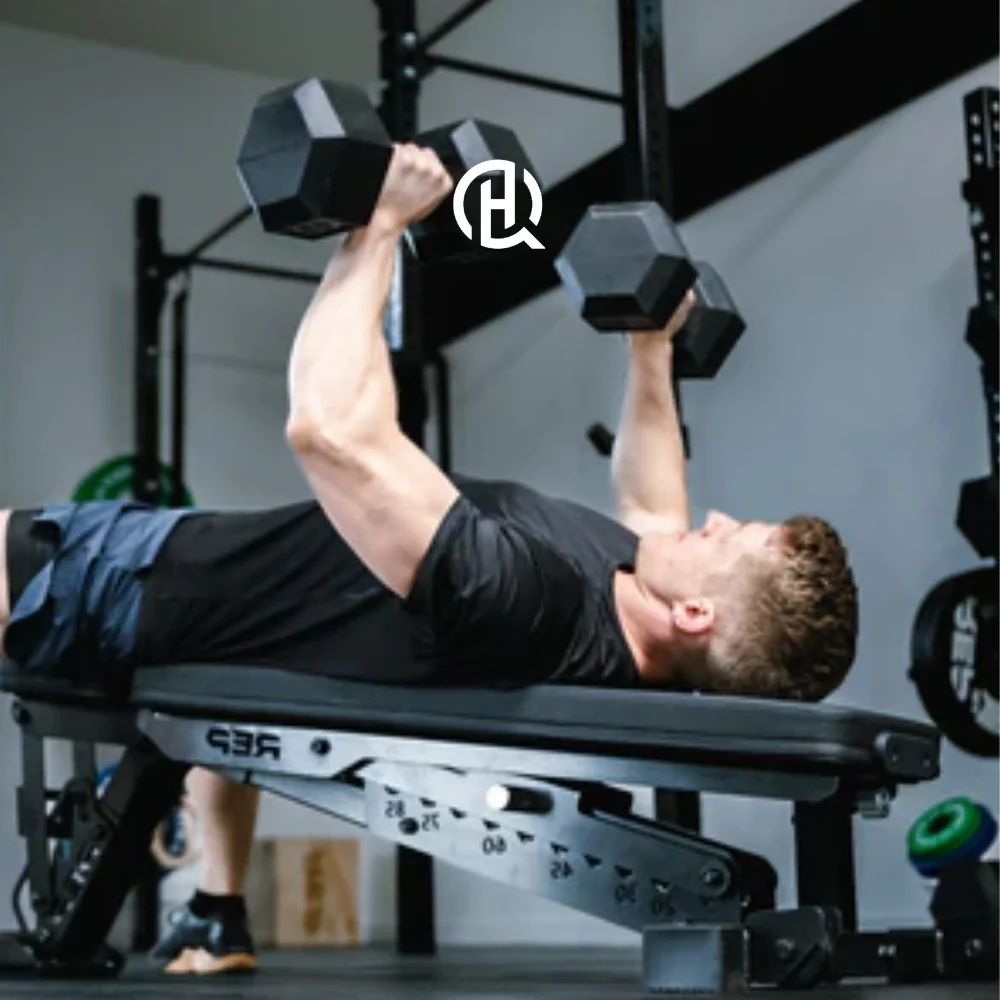

Lower chest activation, greater range of motion, and increased stability are some of the things that make the dumbbell declined bench press such a favorite. In this guide, we will tell you everything you need to know to perform this exercise like a real pro.
Perfecting the Dumbbell Declined Bench Press in 3 Simple Steps
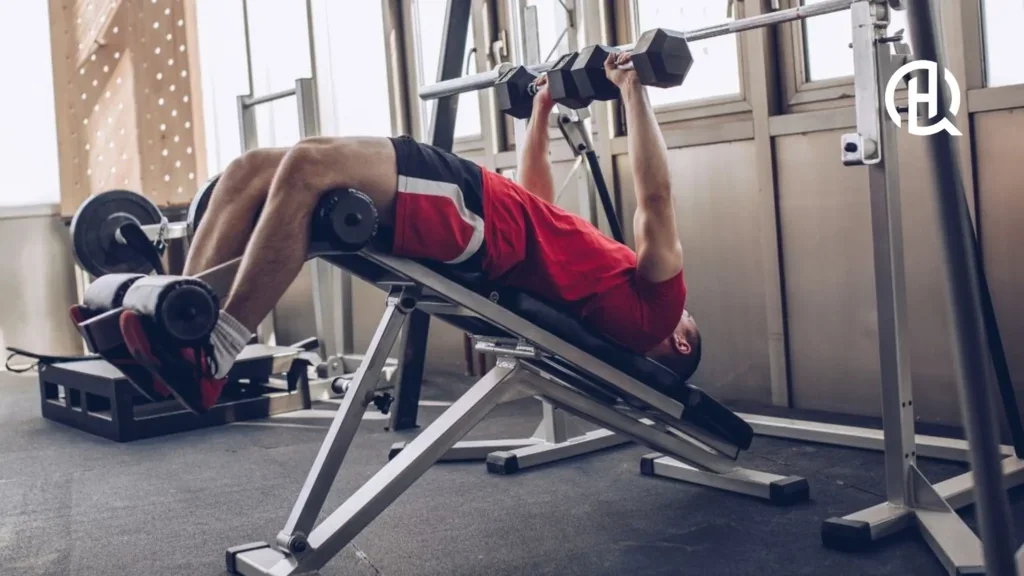
Don't Rush the Reps - Slow and controlled reps maximize gains.
While it may not top the list of the most effective chest exercises in scientific studies, the dumbbell decline bench press stands out for its unique ability to target the lower portion of the pectoralis major. It also offers greater stability, helping you maintain better control throughout the movement.
So, how do you master the dumbbell decline bench press? Just follow these three simple steps:
1. Setup
To perform this exercise, you need two pieces of equipment: dumbbells and a gym bench that, ideally, has footpads. While you can do the dumbbell declined bench press on a bench without footpads, such makes it harder to control the dumbbell's movement.
Before starting, make sure the bench is securely locked into place (i.e., it won't move while you do the reps) and adjust its inclination to an angle of 15 to 30 degrees. In case you're using a bench without footpads, certify that you can comfortably reach the floor with both feet. Or get something to place your feet on.
2. Positioning
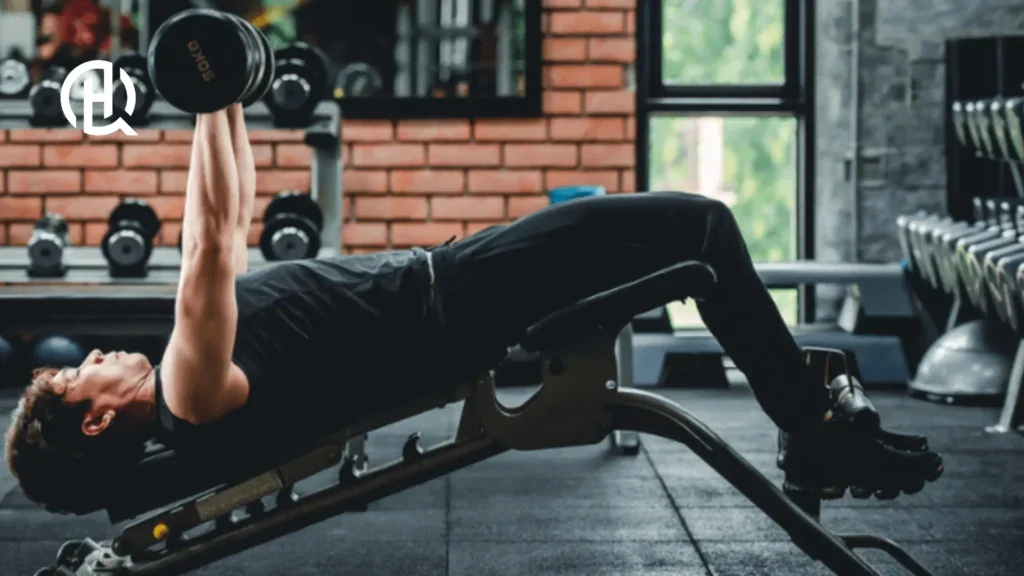
Lie back on the bench holding one dumbbell in each hand. Your forearms should be perpendicular to the floor.
As for your body, it's essential to check that it's perfectly aligned with the bench. Your head, shoulders, and hip should rest comfortably on the bench.
3. Execution
Grab the dumbbells and press them up using a controlled motion; the arms should be fully extended, but without locking the elbows (Keep the tension). For the opposite motion (the lowering of the dumbbells), maintain a 45-degree angle in relation to your body.
Always remember to breathe during your exercises. As a general rule, exhale during the effort phase (when lifting the weight) and inhale during the return phase (as you lower the weight). Alternatively, you can inhale at the top, hold your breath through the movement to create core stability, and exhale once you're back at the top. Repeat this breathing pattern for each rep to maintain control and maximize performance.
When you come down close to your chest, get in a deep stretch before pressing.
Can I use a Bench Without Footpads?
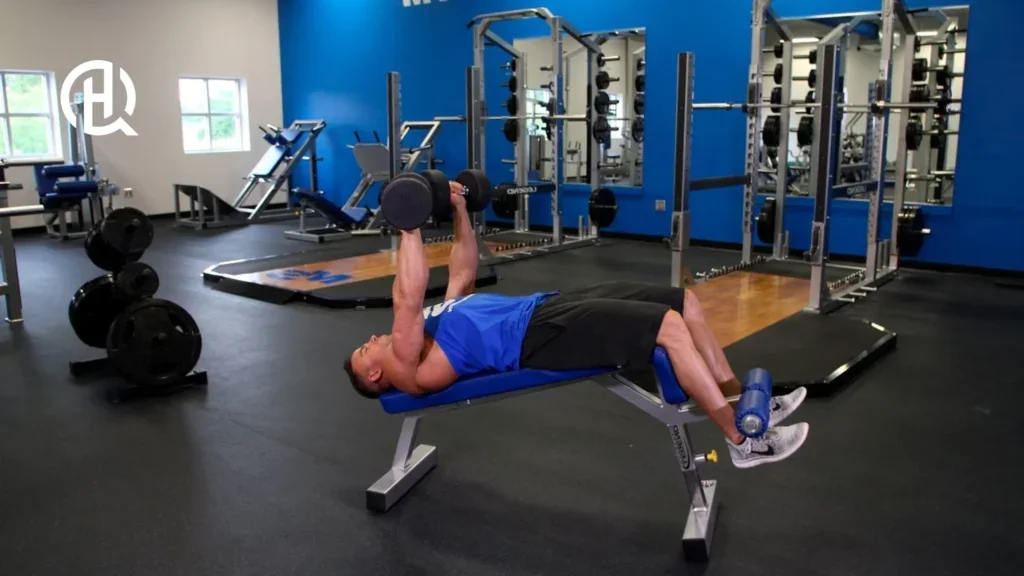
The dumbbell declined bench press is a declined chest exercise, and it's always advisable to use a bench with footpads for this type of workout. However, you can still perform it safely with a run-of-the-mill gym bench if you're experienced enough.
The advantage of using a bench without footpads is that you'll need to engage your core a lot more, therefore strengthening it in the process. But there are better ways of achieving this goal, such as getting our free abs workout program.
With footpads, the dumbbell declined bench press gets much easier because your legs will be locked in one single place, providing more stability. Since your legs are always secured, you don't need to focus on your core and balance as much as with a no-footpad bench, meaning you can control movement more effectively and lift heavier.
How Heavy Should the Dumbbells Be?
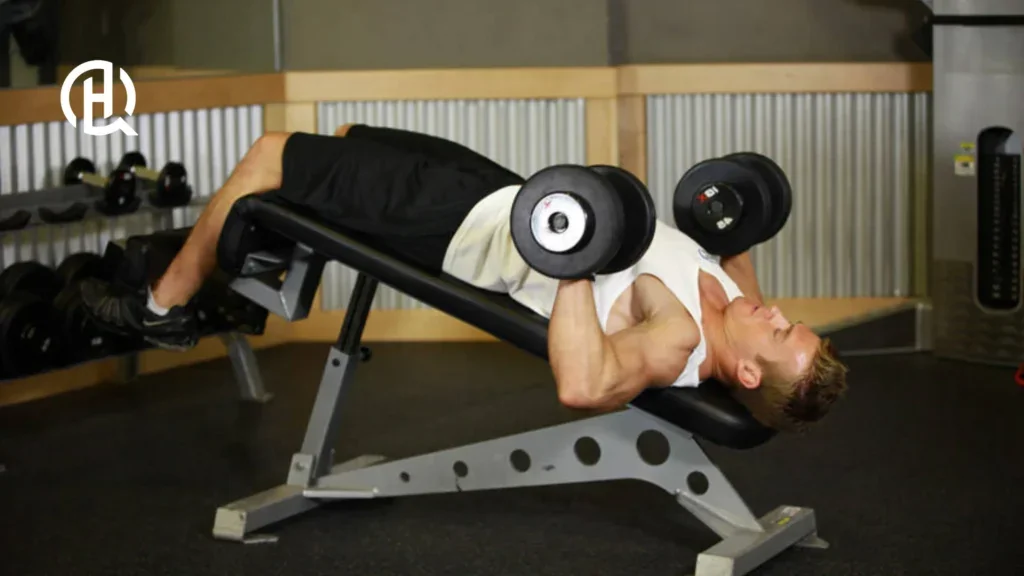
Control the Descent - Lower the dumbbells slowly for better muscle activation.
We get that you want to get results as fast as possible, but using too much weight in the gym is associated with higher risk of injury. So, how do you determine how heavy the dumbbells should be for the dumbbell declined bench press?
Naturally, there's no one definite answer, but we have some general indications. Here's an expert method that usually works:
- 1. Perform a few reps using very light dumbbells, focusing on controlling the movement;
- 2. Add a little bit of weight and continue doing reps;
- 3. Repeat the process until the dumbbell weight makes it difficult to perform the dumbbell declined bench press in a stable and controlled manner.
For beginners, the recommended dumbbell weight is normally between 15 and 25 pounds, but this changes from athlete to athlete.
The Dumbbell Declined Bench Press vs. Other Dumbbell Chest Exercises
Use a Spotter for Heavy Weights - Extra safety, especially on decline.
Finally, let's take a look at how the dumbbell declined bench press compares to other chest exercises involving dumbbells:
- • Incline dumbbell bench press: The only difference is the bench's inclination, but it ends up affecting which chest muscles are activated more. While the dumbbell declined bench press focuses more on the lower chest muscles, the incline dumbbell bench press targets more of the upper chest.
- • Dumbbell fly: Due to its more isolated presses, the dumbbell fly is more effective than the dumbbell declined bench press at isolating the chest;
- • Incline dumbbell fly: Perhaps one of the best alternatives to the dumbbell declined bench press, this exercise has the particularity of isolating the upper chest muscles more specifically than other fly exercises. Also, the lower chest is usually more developed than the upper, therefore focusing on that instead is better.
All things considered, the dumbbell declined bench press is an exercise that, albeit not irreplaceable, should be a part of a complete workout split, especially if you're trying to develop your chest.