Triceps exercise guide
Lying Triceps Extension
The skull crusher, done safely with an EZ-bar or barbell.
Lie on a bench, bend only at the elbows, press the bar back up. Here is how to do the skull crusher without hurting your elbows or your face.

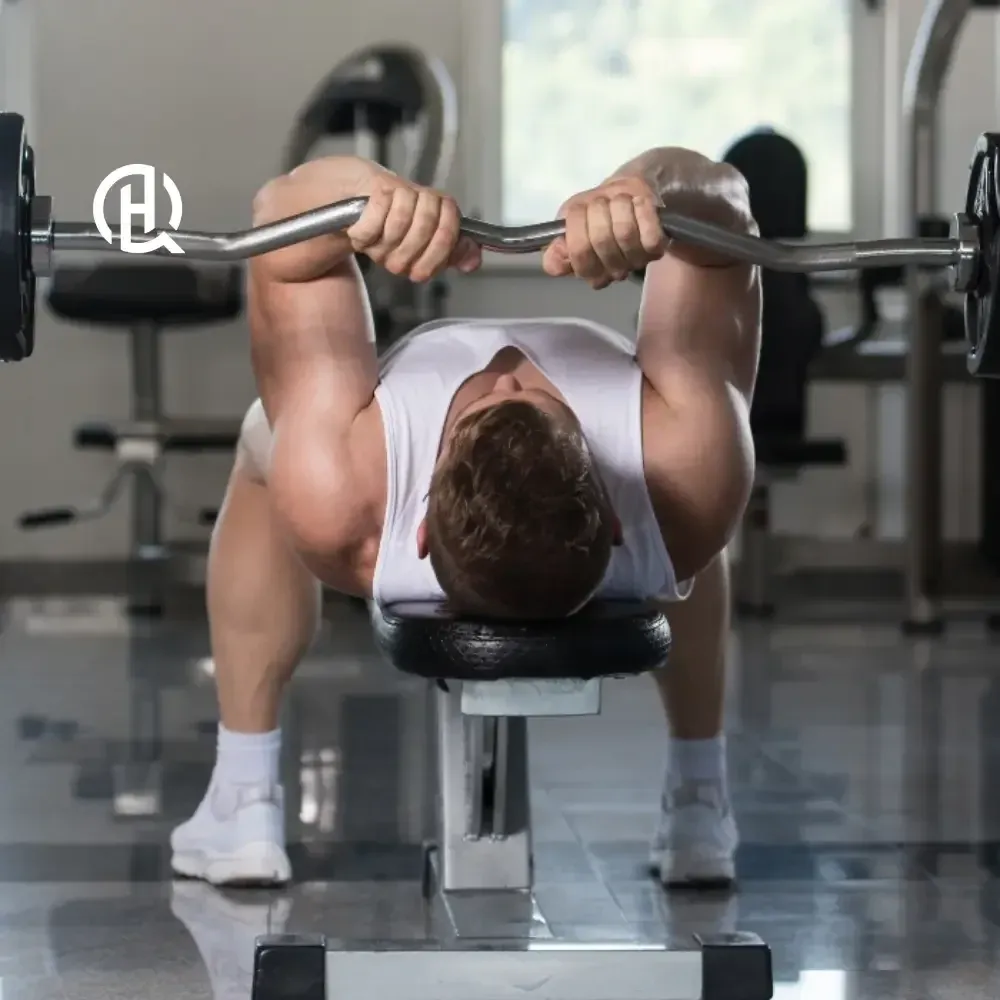
The lying triceps extension, also called the skull crusher, is a triceps exercise done lying on a flat bench. Hold an EZ-bar or barbell above your chest, bend only at the elbows to lower it to your forehead or just behind your head, then press it back up. Few exercises load the triceps better with a bar.
Key takeaways
- Only the elbows bend. Upper arms stay still and tilted slightly back toward your head.
- An EZ-bar is easier on the wrists than a straight bar for most lifters.
- Lowering behind your head gives the long head of the triceps more stretch than lowering to the forehead.
- It is safe with a weight you control. Most problems come from going too heavy and dropping the bar fast.
- 3–4 sets of 8–12 reps after your main pressing is a good default.
- Muscles
- Triceps (all three heads; long head stretched more when lowering behind the head)
- Equipment
- Flat bench, EZ-bar or barbell
- Difficulty
- Intermediate
- Sets & reps
- 3–4 sets of 8–12 reps
Step by step
How Do You Do a Lying Triceps Extension?
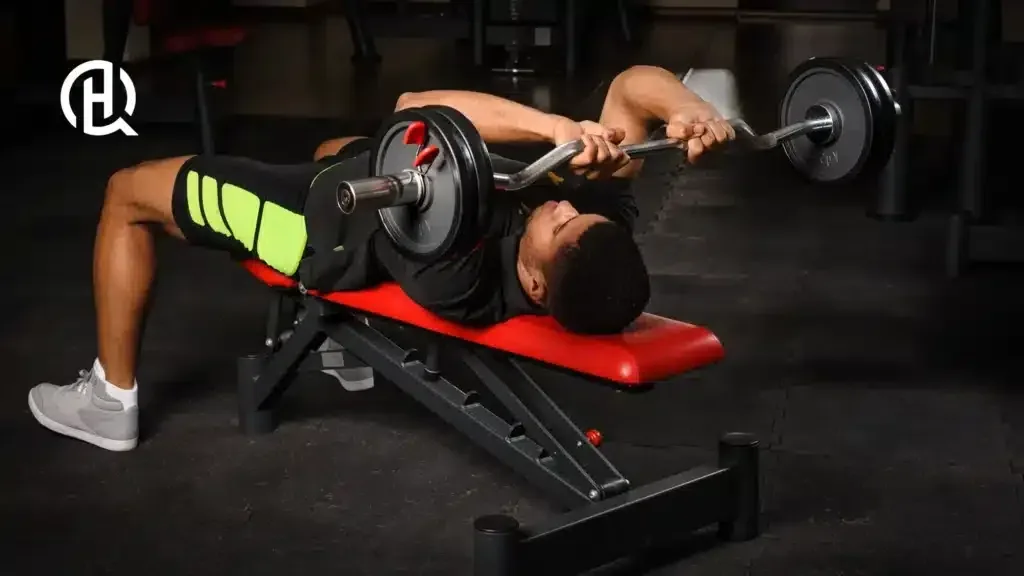
- 01
Load a light bar
Start with an empty EZ-bar or a light fixed bar.
- 02
Lie down
Lie on a flat bench with your head near the end of the bench and both feet flat on the floor.
- 03
Get the bar into position
Hold the bar with an overhand grip, hands about shoulder-width or a little narrower. Press it up so your arms are straight over your chest. With heavier weights, have a partner hand you the bar.
- 04
Set your elbows
Tilt your arms slightly back toward your head, so the bar sits above your eyes rather than your chest. This keeps tension on the triceps at the top.
- 05
Lower with control
Bend only at the elbows and lower the bar over 2–3 seconds to your forehead, or just past it behind your head. Your upper arms do not move.
- 06
Press back up
Straighten your elbows to bring the bar back to the start. Keep your elbows pointing up, not out.
- 07
Breathe
Breathe in on the way down and out as you press up, or take a breath and brace before each rep with heavier sets.
Get it right
Form Cues
Do
- Upper arms locked. Your upper arms stay at the same angle for the whole set. If they swing, you are pressing with your chest and shoulders.
- Elbows in. Keep your elbows about shoulder-width and pointing at the ceiling. Flaring them out takes load off the triceps.
- Slow down, press up. Take 2–3 seconds to lower the bar, then press it back up under control.
- Feet down, back flat. Both feet on the floor, a natural arch in your lower back, nothing more.
Common mistakes
- Moving the upper arms. Letting your elbows drift toward your hips turns the rep into a close-grip press. Lock the upper arms.
- Flaring the elbows. Elbows pointing out move the work away from the triceps and stress the elbow. Keep them in.
- Too heavy, too fast. The most common cause of elbow pain on this exercise. Drop the weight and slow the lowering.
- Lowering to the nose. The bar should come down to the forehead or behind the head, not to the face.
- Lifting your feet or arching hard. Keep both feet on the floor and your back in a normal arch.
Safety
Are Skull Crushers Dangerous?
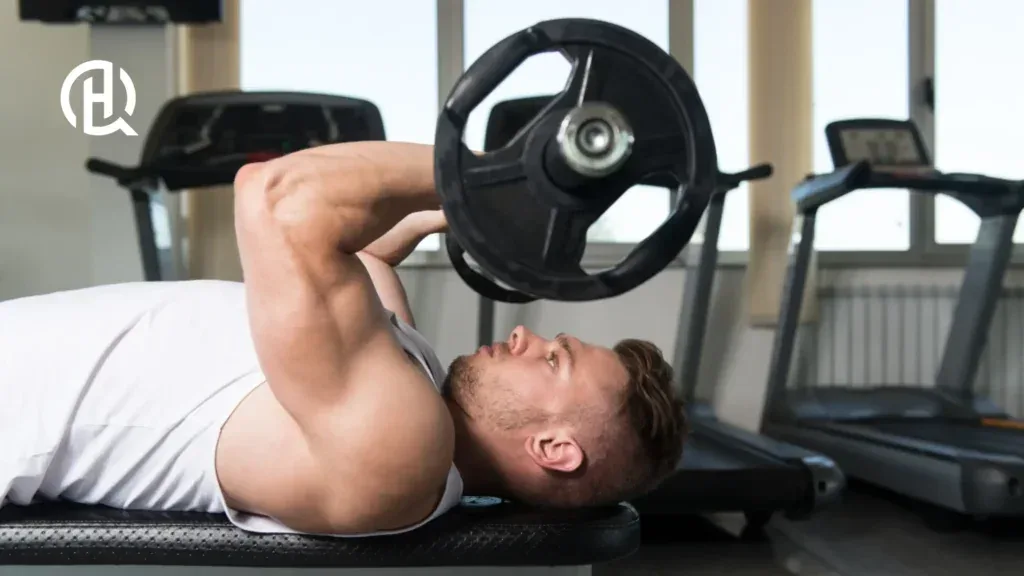
Skull crushers are no more dangerous than other triceps exercises when you use a weight you can control. The name comes from the obvious risk: the bar travels toward your face. Two things cause most problems: a weight that is too heavy, and lowering it too fast.
- Start light. Learn the movement with an empty EZ-bar.
- Control every rep. If you can't take 2–3 seconds to lower the bar, it is too heavy.
- Use a spotter for heavy sets. A partner can hand you the bar and take it if a rep fails.
- Stop if your elbows hurt. Lighten the load, shorten the range, or switch to dumbbells or a cable pushdown. Sharp pain means stop the set.
Equipment
Which Bar Should You Use?
EZ-bar
The zig-zag shape turns your wrists slightly inward. Easier on the wrists for most people. The best default.
Straight barbell
Works, but locks your wrists palms-down. Use it if you don't have an EZ-bar and your wrists feel fine.
Swiss (multi-grip) bar
Neutral handles, palms facing each other. Comfortable if your gym has one; few gyms do.
Dumbbells
Each arm moves on its own and your wrists can turn freely. See the lying dumbbell triceps extension guide.
Swap options
Variations
To the forehead
The classic version. Shorter range, easier to control.
Behind the head
Lower the bar past your head. Your arms are more overhead, so the long head of the triceps gets more stretch. Use a little less weight.
Incline bench
Same movement on a bench set to a low incline. Your arms start further overhead, similar to an overhead extension.
Dumbbells
Neutral grip, one arm at a time if needed.
How much
Sets and Reps by Goal
| Goal | Sets | Reps | Rest |
|---|---|---|---|
| Muscle growth | 3–4 | 8–12 | 60–90 seconds |
| Heavier triceps work | 3–4 | 6–8, EZ-bar, with a spotter | 90–120 seconds |
| Finisher | 2 | 12–15 | 60 seconds |
Do it after your main press, such as the close-grip bench press, and before lighter cable work. Add weight only when every set hits the top of the rep range with slow, clean reps. Muscle growth also needs enough food; see the best diet for muscle growth. For more options, see the full list of triceps exercises.
Fit
Who It's For and Who Should Skip It
Good for: lifters who want a bar-loaded triceps exercise; anyone training for bigger arms who already handles pushdowns and dips.
Skip or adjust if: your elbows ache during or after the lowering phase, or your wrists hurt on a straight bar. Try the EZ-bar, dumbbells, or a cable pushdown. Beginners should learn it light, with an empty EZ-bar, before adding plates.
FAQ
Common Questions
Are skull crushers bad for your elbows?
Not when the weight is right. Skull crushers load the elbow joint, so a weight that is too heavy, a fast lowering or flared elbows can make your elbows sore. Use an EZ-bar, take 2–3 seconds to lower the bar and keep your elbows pointing up. If your elbows still hurt, switch to dumbbells or a cable pushdown and stop if the pain is sharp.
Should you lower the bar to your forehead or behind your head?
Both work. Lowering to the forehead is the classic version and is easier to control. Lowering just behind your head puts your arms further overhead, which stretches the long head of the triceps more. It also keeps the bar further from your face. Start with the forehead version, then try behind the head with a little less weight once the movement feels solid.
Is an EZ-bar or a straight bar better for skull crushers?
For most people, the EZ-bar. Its angled grips turn your wrists slightly inward, which is more comfortable than the fixed palms-down position of a straight bar. The triceps work the same either way, so pick the bar that lets you train without wrist pain. If you have neither, dumbbells work well.
What muscles do skull crushers work?
Skull crushers work the triceps, the muscle on the back of your upper arm. All three heads straighten the elbow, and lowering the bar behind your head adds stretch on the long head, which also crosses the shoulder. Your chest and shoulders only help hold the bar in place. If they start pushing the bar, your upper arms are moving too much.
How many sets and reps of skull crushers should I do?
For muscle growth, 3–4 sets of 8–12 reps with 60–90 seconds rest is a solid default. Heavier sets of 6–8 work with an EZ-bar and a spotter. Do them after your main pressing exercise. Stop each set a rep or two before form breaks, and add weight only when every set reaches the top of the range.
Are dumbbell skull crushers as good as barbell skull crushers?
They train the same muscle, so yes. A bar lets you load heavier and add small jumps in weight. Dumbbells let each arm work on its own and let your wrists turn to a neutral grip, which some lifters find more comfortable. Use the bar as your main version and dumbbells as a variation, or the other way around if your wrists prefer it.
Wrap-up
Final Thoughts
The skull crusher earns its scary name only when the weight is too heavy. Use an EZ-bar, keep your upper arms still, lower slowly and press without flaring. Done that way, it is one of the most useful triceps exercises you can do with a bar.
Tricep Focused
Train your triceps with a plan.
The Tricep Focused program is one of the HermQ bodybuilding programs. One $19/month subscription unlocks every bodybuilding program while it is active.
60-day money-back guarantee.