Back · Lats
Straight-Arm Rope Pulldown
A cable lat exercise with straight arms: setup, cues, mistakes and how to program it.
The straight-arm rope pulldown is the simplest way I know to feel your lats work without your arms joining in. Here is how to set it up, what to feel, and where it fits in a back day.

- Lats: pull down and in
- Upper back: rows and posture
- Biceps: help every pull
The straight-arm rope pulldown is a cable exercise where you keep your arms almost straight and pull a rope from head height down to your thighs. It trains the lats through shoulder extension with little help from the biceps, which makes it a good warm-up or finisher on back day.
Key takeaways
- Your arms stay almost straight. The movement happens at the shoulder, not the elbow.
- The lats do most of the work. The biceps barely help.
- Use a light to moderate weight for 10–15 slow reps.
- Hinge forward slightly and keep your ribs down so your lower back does not arch.
- Use it before pulldowns to wake the lats up, or after rows as a finisher.
- Muscles
- Lats (main), teres major, rear delts, long head of the triceps, core
- Equipment
- Cable machine, rope attachment
- Difficulty
- Beginner
- Sets & reps
- 2–4 sets of 10–15 reps
The basics
What Is a Straight-Arm Rope Pulldown?
The straight-arm rope pulldown is an isolation exercise for the lats. You stand facing a high cable, hold a rope with your arms nearly straight, and sweep the rope down in an arc until your hands reach your thighs.
Because your elbows stay fixed, your biceps cannot pull the weight for you. That is the whole point. On rows and pulldowns many people feel their arms more than their back. Here the lats have to do the job.
Also called: cable straight-arm pulldown, rope straight-arm pulldown, straight-arm lat pulldown. With a straight bar instead of a rope it is the same movement.
Straight-arm pulldown vs lat pulldown
| Feature | Straight-arm rope pulldown | Lat pulldown |
|---|---|---|
| Elbows | Stay almost straight | Bend through the rep |
| Main joint | Shoulder only | Shoulder and elbow |
| Biceps involvement | Very little | Moderate |
| Load | Light to moderate | Moderate to heavy |
| Best use | Warm-up, lat focus, finisher | Main vertical pull |
If you want the bent-arm version, see the close-grip lat pulldown guide.
Step by step
How to Do the Straight-Arm Rope Pulldown
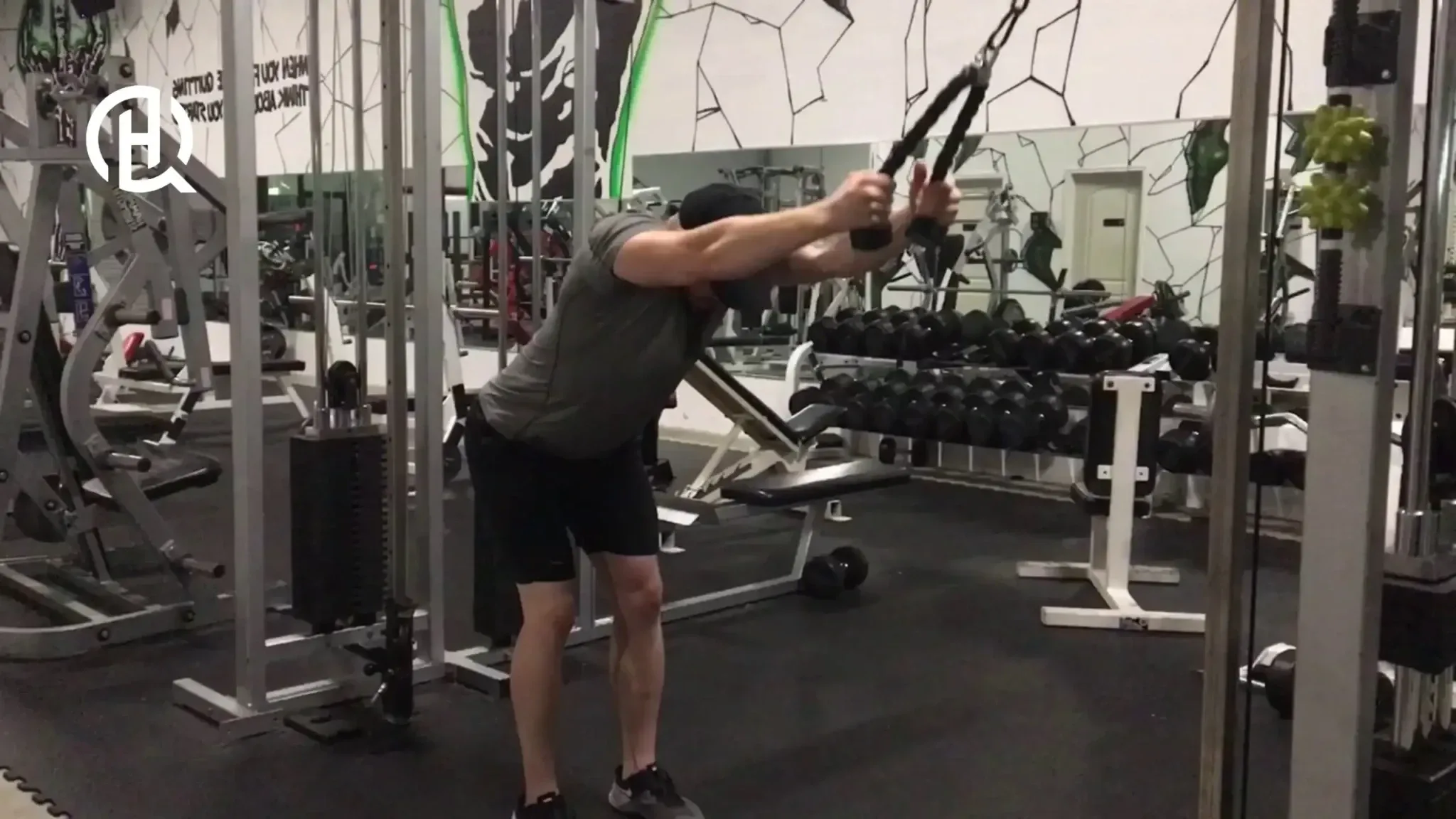
Same small elbow bend from the top of the rep to the bottom.
- 01
Set the rope high
Set a rope attachment at the top of a cable station. Stand facing it, about one big step back.
- 02
Step back
Grab one end of the rope in each hand. Step back until your arms are straight out in front of you at about head height and the weight is lifted off the stack.
- 03
Hinge slightly
Set your feet hip-width apart. Soften your knees and hinge forward slightly at the hips, keeping your back flat.
- 04
Lock the elbow angle
Lock in a small bend at the elbows. Pull your shoulders down, away from your ears.
- 05
Sweep to the hips
Keeping that elbow angle, sweep the rope down in an arc until your hands reach the front of your thighs. Spread the rope ends slightly at the bottom.
- 06
Pause and squeeze
Squeeze your lats for a one-second pause.
- 07
Return slowly
Let the rope rise slowly back to head height, until you feel a stretch under your armpits. Keep your shoulders down. Repeat.
Get it right
Form Cues That Make It Work
- 01
Think "hands to hips, elbows stay quiet."
The elbow angle you start with is the angle you finish with.
- 02
Shoulders down first
Before each rep, pull your shoulder blades down. Then move the arms. Before your working sets, do 1–2 light sets of only the shoulder-blade drop.
- 03
Small hinge, no arch
A slight forward lean lets the cable line up with your lats. Keep your ribs down so the lower back stays neutral.
- 04
Pause at the bottom
One second with the rope at your thighs.
- 05
Slow on the way up
Take about two to three seconds to return.
"When I coach this, the most common fix is the elbows. If they bend more as you pull, the weight is too heavy. Drop it and the lats light up."
Herman Leir, Personal Trainer
Anatomy
Muscles Worked
- Latissimus dorsi (main target): pulls your upper arm down and back toward your hip.
- Teres major: a small muscle under the shoulder blade that helps the lats.
- Rear delts and long head of the triceps: both help extend the shoulder.
- Core: keeps your torso still so you do not rock the weight down.
The biceps do very little because the elbow does not bend.
Why do it
Benefits of the Straight-Arm Rope Pulldown
- 01
Isolates the lats
With the elbows fixed, the lats move the weight. This helps if your arms tire before your back on rows and pulldowns.
- 02
Teaches you to feel your back
Many lifters struggle to feel their lats. A few light sets before your heavy pulls make it easier to find them on the next exercise.
- 03
Low load, easy to recover from
The weight is light, so it adds back work without much strain on your grip or lower back.
- 04
A simple finisher
At the end of a back session it lets you add volume when your grip and biceps are tired.
What to avoid
Common Mistakes
- 01
Bending the elbows
This turns it into a lat pulldown and lets the biceps help. Keep the same small elbow bend all the way.
- 02
Using too much weight
If you have to swing or lean back to finish the rep, it is too heavy. This is a light exercise.
- 03
Arching the lower back
Leaning back and flaring the ribs moves the work away from the lats. Hinge slightly forward and brace.
- 04
Shrugging
If your shoulders rise toward your ears, the upper traps take over. Pull the shoulders down before every rep.
- 05
Rushing the return
Letting the stack yank your arms up skips half the rep. Control it up for two to three seconds.
Options
Variations
Straight-bar straight-arm pulldown
Same movement with a straight bar. A little less range at the bottom, easier to load evenly.
Single-arm straight-arm pulldown
One D-handle, one arm at a time. Good if one side is weaker.
Bent-arm rope pulldown
The elbows bend as you pull, so the arms help more and you can use more weight. You pull the rope toward your upper chest, which makes it closer to a close-grip lat pulldown.
Superset idea
Straight-arm pulldown first, then a set of wide-grip lat pulldowns. The lats are already working when the heavier pull starts.
Programming
Sets and Reps by Goal
| Goal | Sets | Reps | Rest |
|---|---|---|---|
| Warm-up / activation | 1–2 | 12–15, light | 30–60 s |
| Muscle growth | 2–4 | 10–15 | 60–90 s |
| Finisher | 2–3 | 15–20 | 45–60 s |
Stop each working set with one to three reps in reserve. Add reps first, then weight.
Fit check
Who It's For (and Who Should Skip It)
Good for: beginners learning to feel the lats, anyone whose arms tire first on back day, lifters who want back volume without more grip work.
Use with care: if raising your arms overhead hurts your shoulder, shorten the range and keep the top position lower. Stop if you feel sharp pain.
Not a replacement for: heavy pulls. Keep pull-ups or pulldowns in your plan, plus a row such as seated cable rows. For the bigger picture, see the most effective exercise for each muscle group.
Questions
Straight-arm pulldown FAQ
What muscles does the straight-arm rope pulldown work?
The lats are the main target. The teres major, rear delts and the long head of the triceps help pull your arm down from overhead, and your core keeps your torso still. Because your elbows stay almost straight, the biceps do very little. That is why it is a good choice when you want your back, not your arms, to do the work.
Is the straight-arm pulldown better than the lat pulldown?
Neither is better. They do different jobs. The lat pulldown bends the elbows, lets you lift more weight and is a main back exercise. The straight-arm pulldown keeps the elbows fixed, uses less weight and isolates the lats. Most people do best with both: a lat pulldown or pull-up as the main lift, and straight-arm pulldowns as a warm-up or finisher.
Should my arms be completely straight?
No. Keep a small, fixed bend in your elbows so the joint is not locked. The key is that the bend does not change during the rep. If your elbows bend more as you pull the rope down, you have turned it into a pulldown and your biceps are helping. Lower the weight until you can hold the same elbow angle from top to bottom.
How many sets and reps should I do?
For muscle growth, 2–4 sets of 10–15 controlled reps works well, with 60–90 seconds of rest. As a warm-up before pulldowns or rows, 1–2 light sets of 12–15 are enough. As a finisher, 2–3 sets of 15–20. Stop each set with one to three reps left in the tank and add reps before you add weight.
Can beginners do straight-arm rope pulldowns?
Yes. It is one of the easiest back exercises to learn because only one joint moves and the weight is light. Start with a weight you can move for 15 slow reps without bending your elbows or leaning back. It is also a useful way for beginners to learn what working the lats feels like before heavier rows and pulldowns.
Back Focused
Train your back with a plan.
Want lat work like this placed in a full back plan? The BACK FOCUSED program is part of the HermQ bodybuilding programs subscription.
60-day money-back guarantee.