Triceps · Cable exercise
Rope Tricep Pushdown
Step-by-step form, the rope-specific cues, and when to choose the rope over the bar
The rope is the most popular pushdown attachment, and the one most often done badly. Here is how to set it up, what the rope changes, and the cues that keep your triceps doing the work.

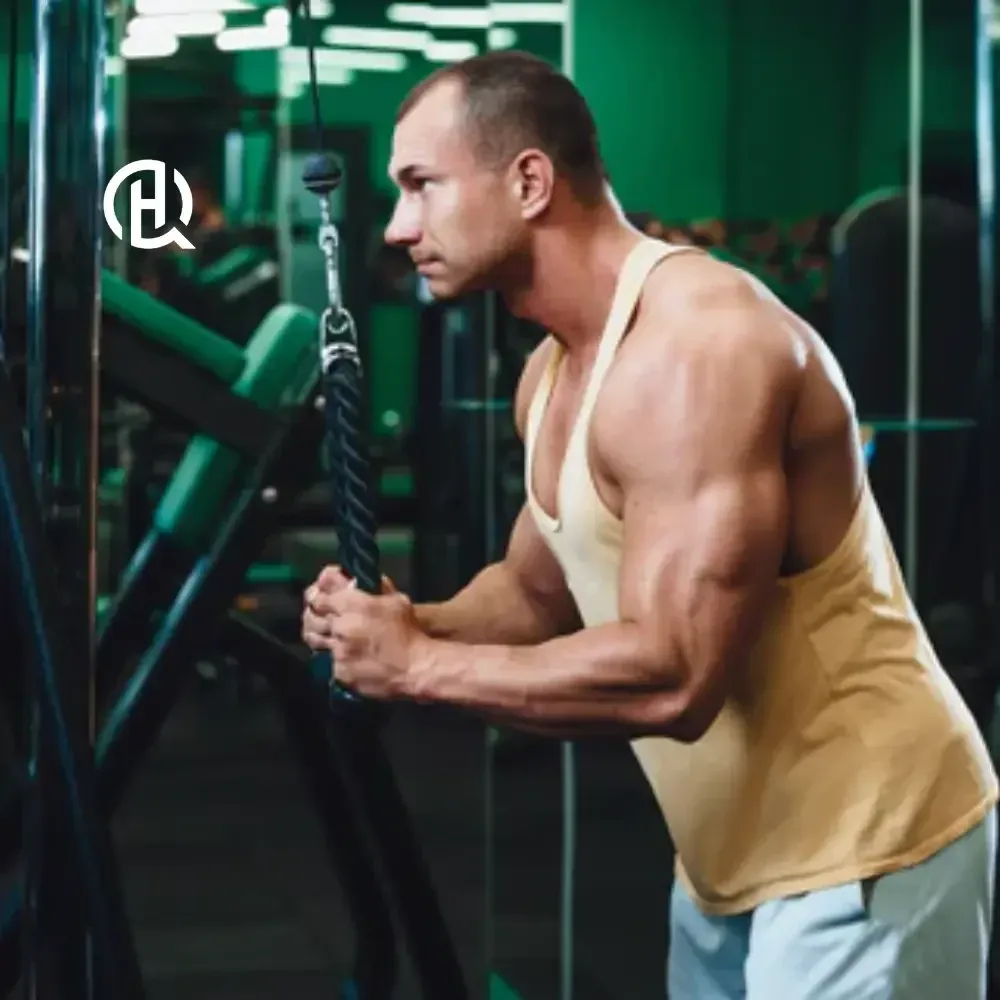
To do a rope tricep pushdown, attach a rope to a high cable, hold the ends with your palms facing each other, pin your elbows to your sides and push down until your arms are straight. At the bottom, spread the rope ends beside your thighs and squeeze. Return slowly. Only your forearms should move.
Key takeaways
- The rope gives a neutral grip, palms facing. Many lifters find it easier on the wrists than a straight bar.
- Spread the rope ends apart at the bottom. That is the rope's main advantage over a bar.
- Elbows stay pinned. If they drift forward or flare, your shoulders take over.
- Expect to use a little less weight than on a straight bar.
- Like every pushdown, it does not stretch the long head. Pair it with an overhead extension.
- Muscles
- Triceps (lateral and medial heads most, long head less)
- Equipment
- Cable machine, high pulley, rope attachment
- Difficulty
- Beginner
- Sets & reps
- 2–4 sets of 10–15 reps
The rope pushdown is one version of the tricep pushdown. If you want the full picture of how it fits with other triceps work, start with the full list of tricep exercises.
Step by step
How to do a rope tricep pushdown
- 01
Set the pulley high
Set the pulley at its highest point and clip on a rope. Do a light warm-up set.
- 02
Grip the rope
Grip the rope just below the end stops, palms facing each other, thumbs up.
- 03
Stand facing the machine
Stand facing the machine, feet shoulder-width apart, half a step back so the cable has tension. Lean forward slightly from the hips with a straight back.
- 04
Pin your elbows
Pin your elbows to your sides. Start with your forearms about horizontal and your hands near chest height.
- 05
Push the rope down
Push the rope down by straightening your elbows. The movement comes from the elbows, not the shoulders.
- 06
Spread the rope ends
Spread the rope ends as your arms straighten, so your hands finish beside your thighs, not in front of them. Squeeze your triceps for a second.
- 07
Return slowly
Return slowly, about two seconds, until your forearms are back to horizontal. Keep control of the weight the whole way.
Get it right
Form cues
- Keep elbows tucked in and still.
- Extend your arms fully at the bottom of every rep.
- Pull the rope apart at the bottom, then bring the ends back together on the way up.
- Thumbs up, wrists straight.
- Chest up, shoulders down. Do not round over the rope.
Avoid these
Common rope pushdown mistakes
- 01
Gripping the knots only
Holding the very ends with a loose grip lets the rope slip and your wrists bend. Grip just below the end stops and hold firmly.
- 02
Hands meeting in front of the thighs
If the rope ends stay together, you lose the rope's advantage. Let them split apart at lockout.
- 03
Too much weight
A heavy rope pushdown turns into a shoulder and bodyweight push. Drop the weight until only your forearms move.
- 04
Elbows flaring on the way up
Elbows that drift out or forward let the shoulders help. Keep them at your sides through the whole rep.
Attachments
Rope vs straight bar: which is better?
| Compare | Rope | Straight bar or V-bar |
|---|---|---|
| Grip | Neutral, palms facing | Palms down |
| Wrist comfort | Easier for many lifters | Can strain the wrists |
| Load | Usually a little lighter | Usually heavier |
| Lockout | Hands spread past the thighs | Hands stop at the bar |
| Stability | Less stable, more control needed | More stable |
Neither is better for everyone. I would use the bar or V-bar when you want to load heavier, and the rope when your wrists or elbows prefer a neutral grip or you want a hard squeeze at lockout. Rotating them every few months is a good default. The other attachments, the V-bar and single handle, are compared in the tricep pushdown guide linked above.
Why do it
Rope pushdown benefits
- 01
Neutral grip
Palms facing is the position many lifters find easiest on the wrists and elbows.
- 02
A full lockout
Spreading the rope lets your hands travel past your thighs for a hard squeeze at the bottom.
- 03
Easy to learn and load
Like every pushdown, it isolates the triceps without tiring your chest or shoulders.
- 04
Steady resistance
The cable pulls in one direction, so the load stays more even through the rep than with a dumbbell.
Options
Rope pushdown variations
- 01
Single-arm pushdown
One hand on a D-handle or half the rope. Good for evening out a weaker side. Full guide: single-arm cable triceps extension.
- 02
Reverse grip pushdown
An underhand grip on a straight bar or D-handle. Use lighter weight. Full guide: reverse grip cable triceps extension.
- 03
Pause pushdown
The same rope pushdown with a one-second pause at lockout.
- 04
Overhead rope extension
Face away from a low or mid cable and extend the rope overhead. It stretches the long head, which the pushdown does not.
Programming
Sets & reps by goal
| Goal | Sets | Reps | Rest |
|---|---|---|---|
| Muscle growth | 3–4 | 10–15 | 60–90 s |
| Finisher or pump | 2–3 | 15–20 | 45–60 s |
| Technique practice | 2 | 12–15, light | 60 s |
General guidance. The rope works best as the second or third triceps exercise, after a heavy press or an overhead extension.
Fit
Who it's for, and who should skip it
Good for: lifters whose wrists dislike a straight bar, beginners learning to feel their triceps, and anyone who wants a controlled finisher at the end of a push or arm day.
Skip or modify: if you want to move the heaviest load, use a bar or V-bar. If the elbow feels sharp pain, stop and lower the weight or switch exercises.
Questions
Rope tricep pushdown FAQ
What muscles does the rope tricep pushdown work?
The rope pushdown works the triceps brachii on the back of your upper arm. All three heads straighten the elbow, but with your arms at your sides the lateral and medial heads do most of the work. Your shoulders, upper back and core hold you steady. The long head is not stretched in this position, so add an overhead extension if you want to train it fully.
Is the rope pushdown better than the bar pushdown?
Not better, different. The rope gives a neutral grip that many lifters find easier on the wrists, and you can spread the ends for a stronger squeeze at the bottom. The bar is more stable and usually lets you lift more. If the bar hurts your wrists, use the rope. If you want to load heavier, use the bar. Rotating both works well.
Should you spread the rope at the bottom of a pushdown?
Yes. Pulling the rope ends apart as your arms straighten lets your hands finish beside your thighs instead of in front of them. That gives you a fuller lockout and a harder squeeze, which is the main reason to use a rope at all. Bring the ends back together as you return to the start, and keep your elbows pinned throughout.
Why can I lift less weight on the rope than the bar?
The rope is less stable, so more of your effort goes into controlling it, and the spread at the bottom asks your triceps to finish the full range. A loose grip on the rope also limits how much you can hold. Expect to use somewhat less weight than on a straight bar. That is normal and not a reason to avoid the rope.
How many sets and reps of rope pushdowns should I do?
For muscle growth, 3 to 4 sets of 10 to 15 reps is a good starting point, with 60 to 90 seconds of rest. Use a weight that makes the last two reps hard while your elbows stay still. As a finisher after heavier triceps work, 2 to 3 sets of 15 to 20 reps is enough. Add weight when every set reaches the top of the range.
Tricep Focused
Train your triceps with a plan.
TRICEP FOCUSED is one of HermQ's bodybuilding programs. One $19/month subscription unlocks every bodybuilding program while it is active.
60-day money-back guarantee.