Triceps exercise guide
Reverse Grip Cable Triceps Extension
The underhand pushdown: how to do it, why the grip matters and when to use it.
A pushdown with your palms facing up. Here is how to set it up, the cues that keep it strict, and where it fits in a triceps workout.

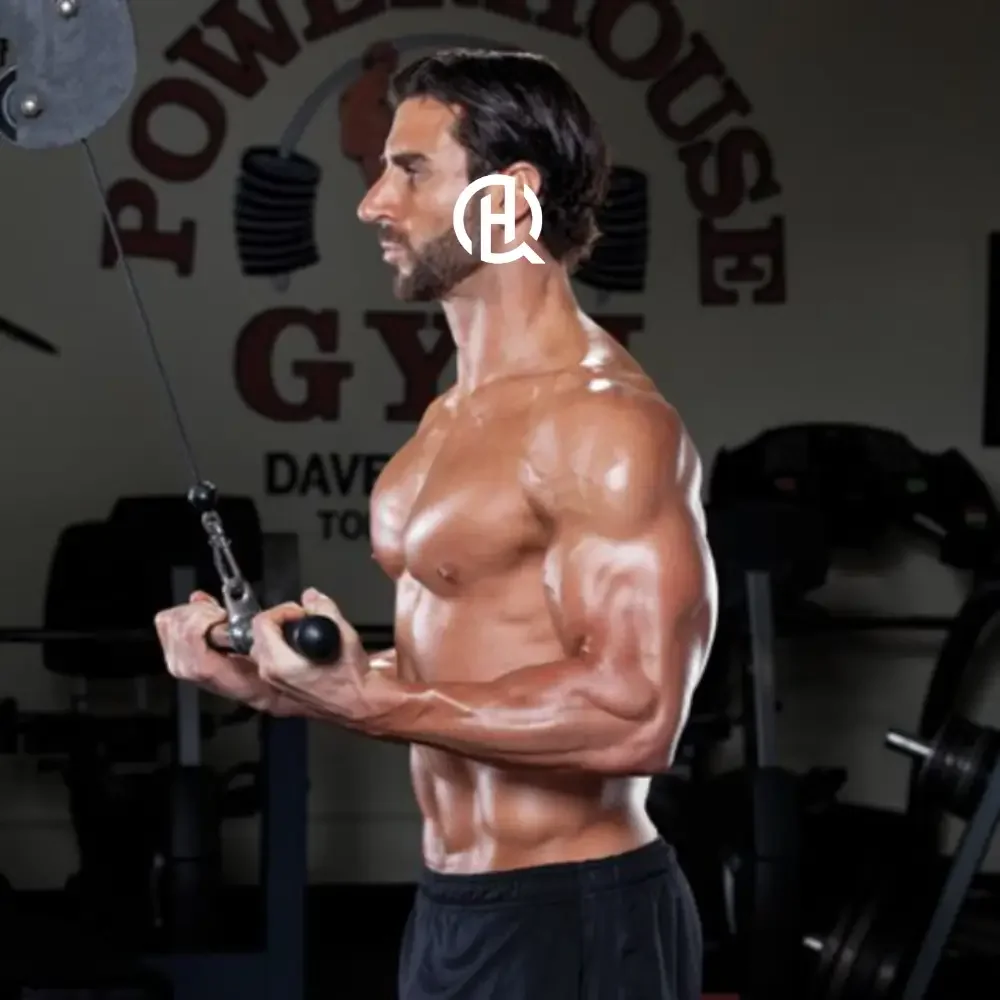
The reverse grip cable triceps extension is a pushdown done with your palms facing up. Attach a straight bar or EZ-bar to a high pulley, pin your elbows to your sides and straighten your arms until they lock out. Use less weight than a normal pushdown, and do it late in your workout for strict, controlled triceps work.
Key takeaways
- It is a triceps isolation exercise. Only your elbows move.
- The underhand grip makes it easier to keep your elbows tucked and harder to lean your body weight into the bar.
- You will lift less than on an overhand pushdown. That is normal, not a sign of weak triceps.
- It works best as your second or third triceps exercise, for 10–15 controlled reps.
- If the grip hurts your wrists or elbows, switch to a rope or an overhand bar.
- Muscles
- Triceps (all three heads); forearms hold the grip
- Equipment
- Cable station, high pulley, straight bar or EZ-bar
- Difficulty
- Beginner to intermediate
- Sets & reps
- 2–4 sets of 10–15 reps
Step by step
How Do You Do a Reverse Grip Cable Triceps Extension?
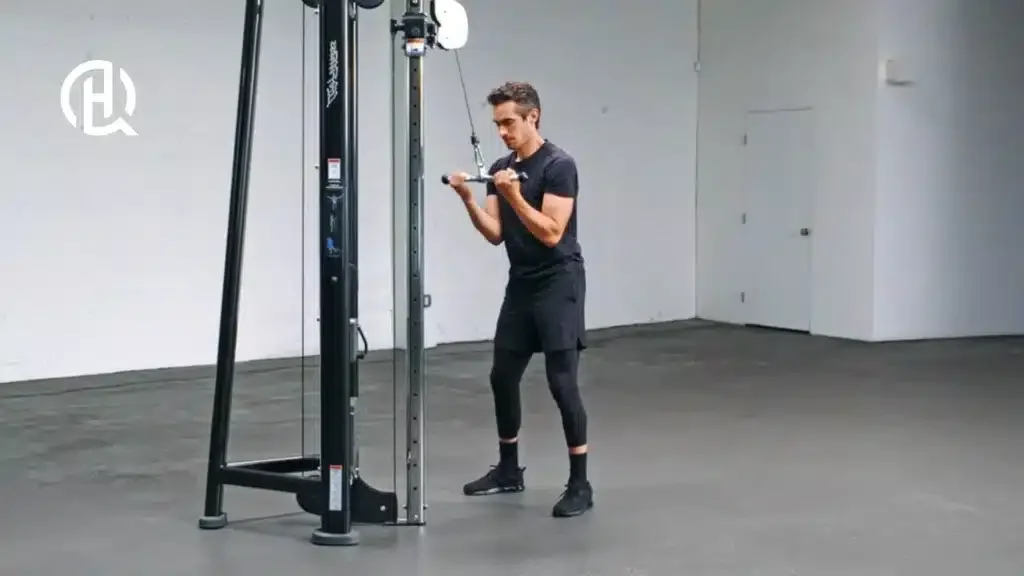
- 01
Set up the cable
Put the pulley at the top and attach a straight bar or an EZ-bar. Pick a weight about a third lighter than you use for normal pushdowns to start.
- 02
Grip palms up
Hold the bar underhand, hands about shoulder-width apart or a little narrower. Wrap your thumbs around the bar.
- 03
Stand close and brace
Step in so the cable runs just in front of your face. Stand tall with a slight forward lean from the hips, knees soft, abs tight.
- 04
Set your elbows
Pull the bar down until your upper arms are by your sides, elbows just in front of your ribs. This is where they stay for the whole set.
- 05
Push down
Straighten your elbows until your arms are fully straight. Hold the lockout for a second and squeeze the back of your arms.
- 06
Control the way up
Let the bar rise over 2–3 seconds until your forearms pass parallel to the floor, or as high as you can go without your elbows moving.
- 07
Breathe and repeat
Breathe out as you push down, breathe in as the bar comes up.
Get it right
Form Cues That Keep It Strict
Do
- Elbows stay put. Upper arms by your sides, elbows just in front of your ribs. If they slide forward or back, your shoulders are doing the work.
- Wrists straight. Keep your knuckles in line with your forearms. Do not let the bar roll your wrists back.
- Finish every rep. Straighten your arms all the way at the bottom. The lockout is where the triceps work hardest.
- Slow on the way up. Two to three seconds up. If the stack slams or the bar yanks your hands up, the weight is too heavy.
Common mistakes
- Going too heavy. Palms up, your grip and wrists give out before your triceps. Drop the weight and get 10 clean reps.
- Elbows drifting. Elbows that swing forward turn it into a shoulder press-down. Pin them and keep them there.
- Leaning over the bar. Bending forward lets body weight push the bar. Stay tall with a slight hip hinge.
- Half reps. Stopping short of lockout skips the hardest part of the rep. Straighten your arms fully every time.
- Bent-back wrists. Letting the bar sit in your fingers bends the wrists back. Hold it in the palm, knuckles in line with the forearm.
The grip
Why Use a Reverse Grip?
The triceps attach at the elbow, on the ulna. Turning your palms up does not change what the muscle does: it straightens your elbow either way. What the grip changes is how your arm moves and how easy it is to cheat.
- 01
Your elbows stay tucked
With an overhand grip, the elbows tend to flare out as the set gets hard. Palms up, they naturally stay close to your body.
- 02
Less room to cheat
You can't lean on the bar and push with your body weight as easily, so the triceps do the work.
- 03
A different feel for the same muscle
If normal pushdowns have gone stale, the grip change lets you keep training the triceps from a new position.
- 04
Light weight, high quality
Because the load is lower, it is a good choice late in a session when you want clean reps, not heavy ones.
"I treat this as a quality exercise, not a strength test. If you want to move heavy weight for your triceps, use the close-grip bench press or dips. Use the reverse grip afterwards for clean, controlled reps."
Herman Leir, Personal Trainer
Programming
When Should You Use It?
Put it after your heavy pressing. A typical triceps order is a compound lift first, such as the close-grip bench press or parallel bar dips, then one or two isolation exercises. The reverse grip pushdown fits in that second slot, or as the last exercise of an arm day.
Three good uses:
- Second or third triceps exercise after a compound press.
- Finisher at the end of an arm or push day, for 2 sets of 15–20.
- A lighter arm day when you want triceps volume without heavy loading.
For the full picture of where each triceps exercise fits, see the complete list of triceps exercises.
Swap options
Variations
EZ-bar reverse grip
The angled handles turn your wrists slightly inward. Many lifters find this more comfortable than a straight bar.
Single-arm reverse grip
One D-handle, one arm at a time. Good for evening out a weaker side. See the single-arm reverse grip guide.
Overhand pushdown
The standard version, where you can use more weight. See the tricep pushdown guide.
Rope pushdown
Lets you spread your hands at the bottom for a harder squeeze. See the rope tricep pushdown.
How much
Sets and Reps by Goal
| Goal | Sets | Reps | Rest |
|---|---|---|---|
| Muscle growth | 3–4 | 10–15 | 60–90 seconds |
| Finisher | 2–3 | 15–20 | 45–60 seconds |
| Light or technique day | 2 | 12–15 | 60 seconds |
| Max strength | Not the best tool. Use close-grip bench or dips. | ||
These are general starting ranges. Stop each set one or two reps before your form breaks. When you can hit the top of the rep range on every set, add a little weight, usually the smallest plate on the stack.
Fit
Who It's For and Who Should Skip It
Good for: anyone who already does pushdowns and wants a variation; lifters whose elbows flare on overhand pushdowns; arm days that need more triceps volume without more heavy pressing.
Skip or adjust if: the underhand grip hurts your wrists or elbows (try an EZ-bar, a rope, or an overhand bar), or you are new to cable training and have not learned a normal pushdown yet. Stop the set if you feel sharp pain.
FAQ
Common Questions
What muscles does the reverse grip tricep pushdown work?
It works the triceps, the three-headed muscle on the back of your upper arm that straightens the elbow. All three heads join into one tendon at the elbow, so a pushdown trains the whole muscle. Your forearm and grip muscles also work to hold the bar palms up, which is one reason you will use less weight than on a normal pushdown.
Is the reverse grip pushdown better than the normal pushdown?
Not better, just different. The overhand pushdown lets you use more weight. The reverse grip makes it easier to keep your elbows tucked and harder to cheat with body weight, so it suits lighter, stricter sets. Most people do best using the overhand or rope version as their main pushdown and the reverse grip as a variation or finisher.
Why can I lift less weight with a reverse grip?
Holding a bar palms up is harder for your grip and wrists than holding it palms down, and you can't lean over the bar as easily to help it down. Both limit the load before your triceps reach their limit. That is fine. Pick a weight you can control for 10–15 reps and progress from there.
Should I use a straight bar or an EZ-bar for reverse grip pushdowns?
Use whichever feels better on your wrists. A straight bar forces your palms to face straight up. An EZ-bar's angled grips let your wrists turn slightly inward, and many lifters find that more comfortable. If both cause discomfort, use a rope or switch to a single-arm version with a D-handle, which lets your wrist find its own position.
How many sets and reps of reverse grip pushdowns should I do?
For muscle growth, 3–4 sets of 10–15 reps with 60–90 seconds of rest is a good start. As a finisher, 2–3 sets of 15–20 reps works well. Stop each set a rep or two before your form breaks, and add weight only when you hit the top of the range on every set with clean reps.
Wrap-up
Final Thoughts
The reverse grip cable triceps extension is a simple exercise that is easy to do badly. Go lighter than you think, pin your elbows, lock out every rep and control the bar up. Do that, and it earns its place after your heavy pressing.
Tricep Focused
Train your triceps with a plan.
The Tricep Focused program is one of the HermQ bodybuilding programs. One $19/month subscription unlocks every bodybuilding program while it is active.
60-day money-back guarantee.