Exercise guide
Wide-Grip Lat Pulldown
Setup, grip width and form cues for a wider back.
The wide-grip lat pulldown is the standard back exercise in almost every gym. Here is how to set it up, how wide to grip, and how to make every rep count.

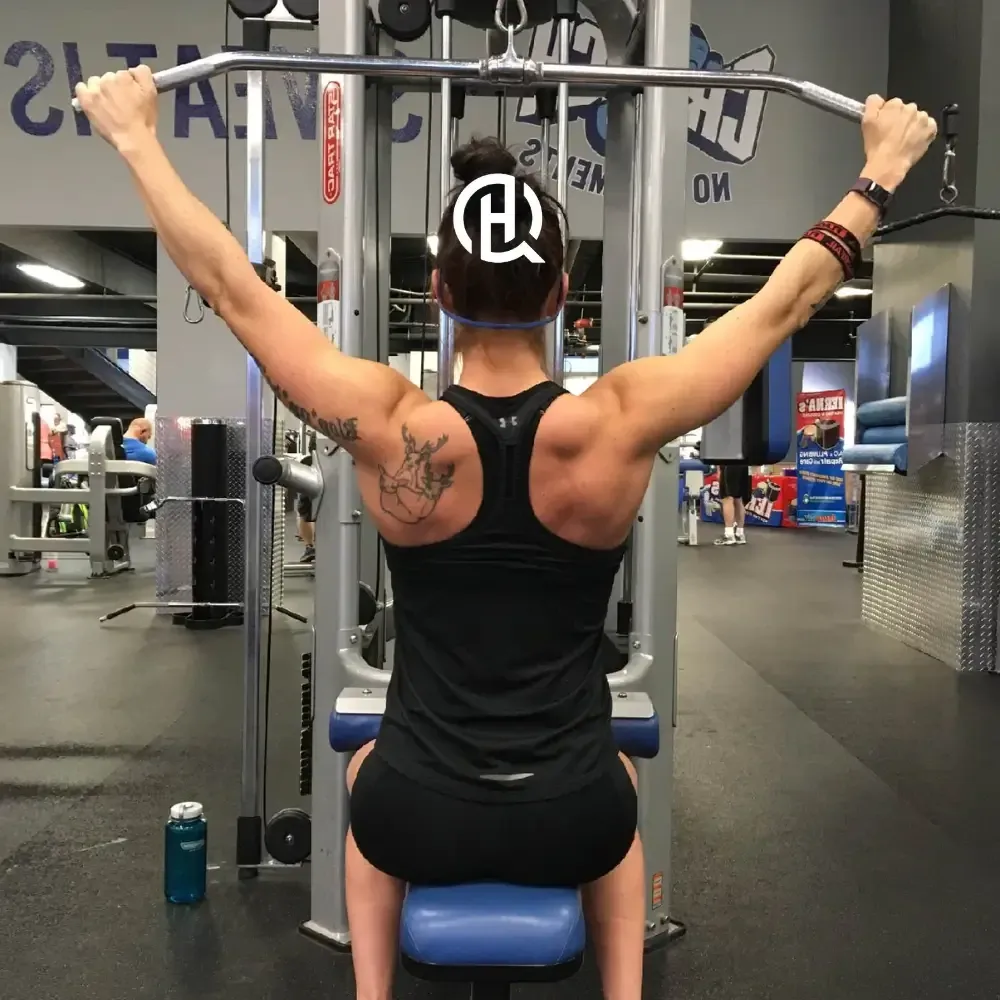
The wide-grip lat pulldown is a cable exercise where you sit under a thigh pad, take an overhand grip about one and a half times shoulder width, and pull the bar to your upper chest. It mainly trains the lats, with help from the biceps, rear delts and mid-back. It is also the standard way to build toward pull-ups.
Key takeaways
- Grip about 1.5 times shoulder width, overhand. Wider than that mostly shortens the pull.
- Start each rep by pulling your shoulder blades down, then drive your elbows toward your ribs.
- Pull to your upper chest, in front of your face. Lean back only slightly.
- Control the bar on the way up for two to three seconds, all the way to straight arms.
- 3–4 sets of 8–12 reps suits most people building muscle.
- For Muay Thai and MMA, it trains the downward pull you use in the clinch, and it still works on days your grip is tired.
- Muscles
- Lats (main), teres major, biceps, rear delts, mid and lower traps, rhomboids
- Equipment
- Lat pulldown machine, long straight bar
- Difficulty
- Beginner
- Sets & reps
- 3–4 sets of 8–12, 60–90 s rest
Step by step
How to Do the Wide-Grip Lat Pulldown
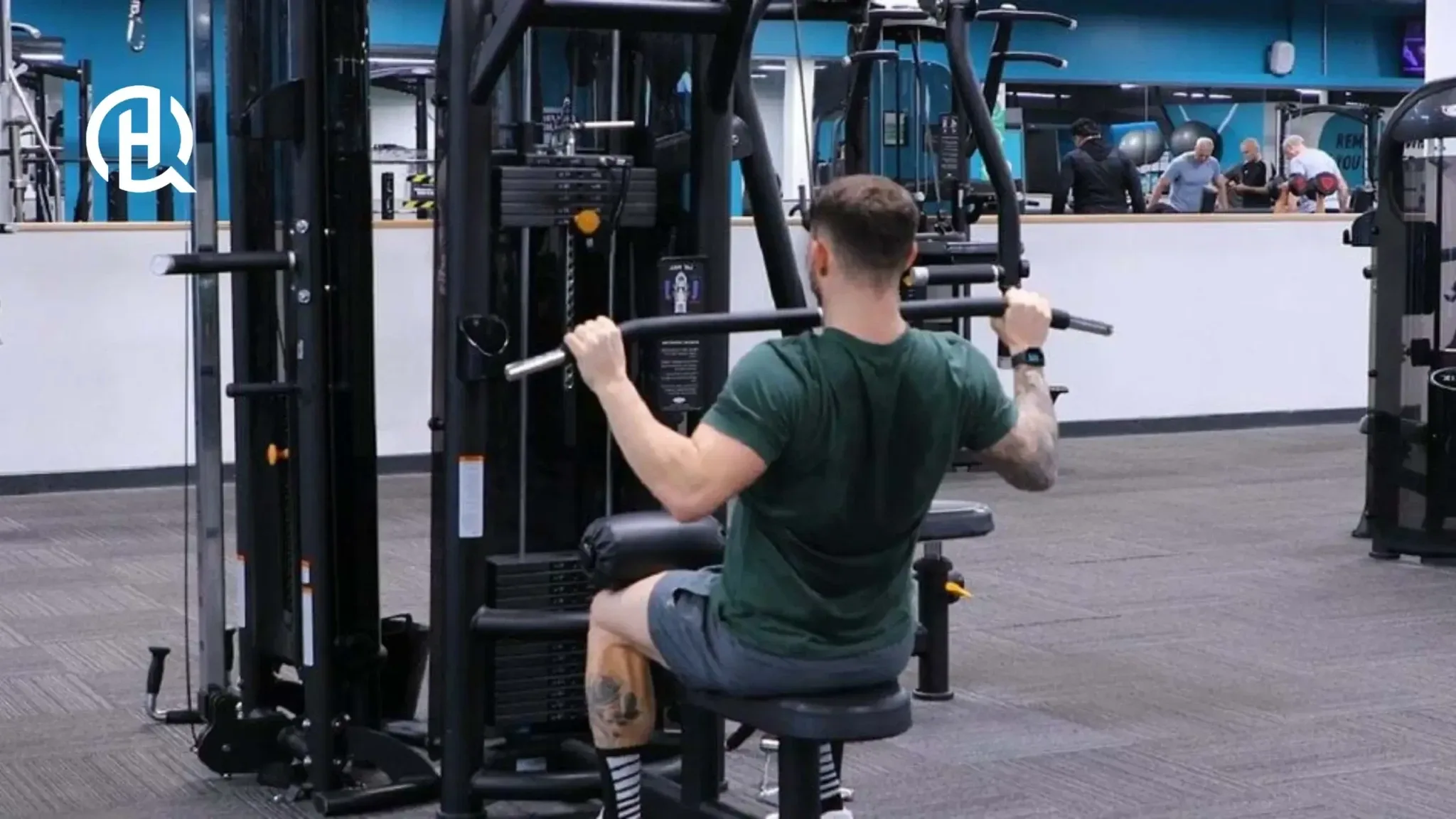 Watch the demo
A HermQ trainer demonstrating the wide-grip lat pulldown.
- 01
Set the pad
Adjust the thigh pad so your thighs are locked in and your feet are flat on the floor.
- 02
Grip the bar
Stand, take an overhand grip about one and a half times shoulder width, then sit down with the bar overhead and your arms straight.
- 03
Sit tall
Chest up, slight lean back of about 10–20 degrees, core tight.
- 04
Start with your shoulder blades
Pull them down and slightly together before your elbows bend.
- 05
Pull to your chest
Drive your elbows down toward your ribs and bring the bar to your upper chest. Pause for a second.
- 06
Return slowly
Let the bar rise over two to three seconds until your arms are straight and you feel a stretch in your lats.
For a one-screen version, use the wide-grip pulldown exercise card.
Get it right
Form Cues
- 01
Elbows, not hands
Imagine your hands are hooks and your elbows do the pulling.
- 02
Bar to chest
Upper chest, in front of your face. Never behind the neck.
- 03
Chest up
Lift your chest to meet the bar instead of leaning far back.
- 04
Full stretch
Arms straight at the top of every rep.
Anatomy
Muscles Worked in the Lat Pulldown
| Muscle | Role |
|---|---|
| Latissimus dorsi | Main mover. Pulls the upper arm down toward your side. |
| Teres major | Small muscle under the armpit that helps the lats. |
| Biceps and brachialis | Bend the elbow. |
| Rear delts | Help pull the arm down and back. |
| Mid and lower traps, rhomboids | Pull the shoulder blades down and together. |
| Core | Keeps your torso still. |
These are the same muscles as the pull-up. The difference is that you choose the weight, which makes the pulldown easier to scale. See how to do pull-ups.
Grip
How Wide Should Your Grip Be?
About one and a half times shoulder width works for most people. A simple check: at the bottom of the rep, your forearms should be close to vertical when viewed from the front.
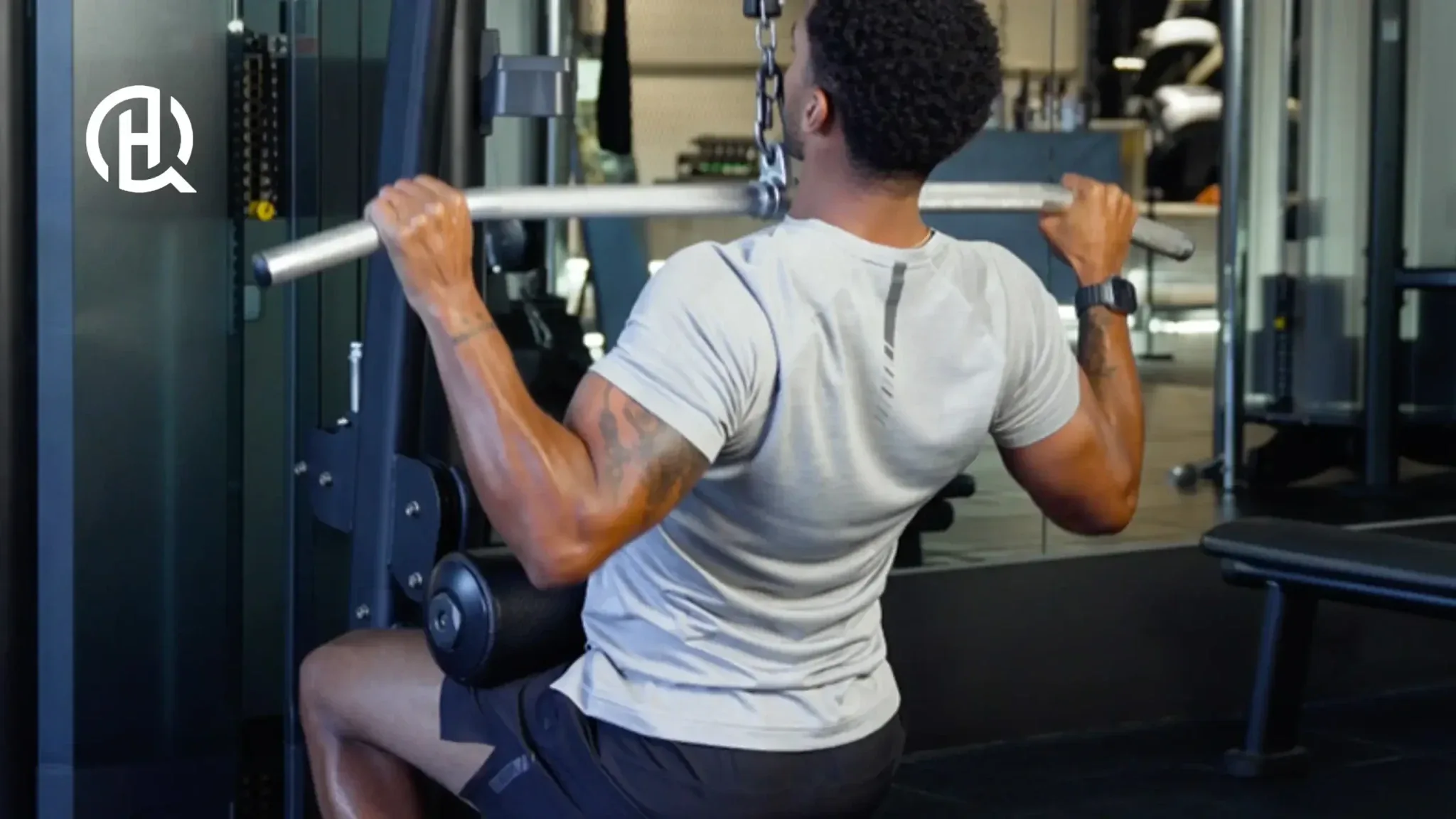
Going much wider shortens the range of motion and rarely feels better in the lats. Going narrower, or switching to a V-bar, gives a longer pull with more biceps help. That is the close-grip lat pulldown, which also has a full close-vs-wide comparison.
| Feature | Wide grip | Close grip (V-bar) |
|---|---|---|
| Grip | Overhand, about 1.5× shoulder width | Neutral, palms facing |
| Range of motion | Shorter | Longer |
| Biceps help | Less | More |
| Best for | Standard lat work, building toward pull-ups | Long-range lat work, lifters who prefer a neutral grip |
What to avoid
Common Lat Pulldown Mistakes
- 01
Swinging or using momentum
If your torso rocks back to start the rep, the weight is too heavy.
- 02
The wrong grip width
Hands extremely wide, or right next to each other on a straight bar. Use about 1.5 times shoulder width.
- 03
Letting the bar snap up
You lose the stretch and the control. Two to three seconds on the way up.
- 04
Leaning far back
Past about 30 degrees it turns into a row. Sit tall.
- 05
Pulling behind the neck
It asks a lot of your shoulders for no extra lat work. If you want to try it, read the behind-the-neck lat pulldown guide first.
Programming
Sets and Reps by Goal
| Goal | Sets × reps | Rest |
|---|---|---|
| Muscle size | 3–4 × 8–12 | 60–90 s |
| Strength | 3–5 × 5–8 | 2–3 min |
| Building toward pull-ups | 3–4 × 6–10, adding weight over time | 90 s |
| Technique, warm-up | 2 × 12–15, light | 60 s |
When you reach the top of the rep range on every set, add one plate step.
Options
Lat Pulldown Variations
Close-grip lat pulldown
V-bar, palms facing. Longer range, more biceps.
Reverse-grip lat pulldown
Underhand grip at shoulder width. Closest to a chin-up. See the reverse-grip lat pulldown guide.
Behind-the-neck lat pulldown
Bar lowered behind the head. Only for lifters with the shoulder mobility for it.
Straight-arm rope pulldown
Arms stay straight; trains the lats without the biceps.
Why do it
Benefits of the Wide-Grip Lat Pulldown
- 01
Trains the lats for a wider back
The lats give your back its width. The pulldown loads them through a long range with a weight you control.
- 02
Builds toward pull-ups
It trains the same pulling pattern as a pull-up, so it is the standard way to build the strength for your first reps.
- 03
Easy to scale and progress
You pick the weight in small steps, which makes it suitable from day one in the gym and easy to progress for years.
- 04
Balances your pressing
If you bench and press a lot, pulling work like this keeps your upper-body training balanced.
Combat sports
Wide-Grip Lat Pulldown for Fighters
Strong lats help whenever you pull an opponent down or toward you. In the Muay Thai clinch you pull down on the head to break their posture. In MMA and grappling you drag an opponent in or hold them down. The lat pulldown trains that downward pull with a weight you can set exactly.
That makes it easy to fit around fight training. When your grip is tired from clinching or rolling, the pulldown still works the lats, and straps are fine on the heavier sets.
A good fighter swap is the half-kneeling single-arm cable pulldown. You pull with one arm and keep your torso square, which is closer to how you pull in a clinch.
For the bigger plan, see strength and conditioning for fighters.
When
Train it on a lighter skill day, or several hours before or after sparring.
How much
Two or three working sets, each one to three reps short of failure. Drop a set or two in the last couple of weeks before a fight.
Balance
Pair each pull with a press so pushing and pulling stay even.
FAQ
Lat Pulldown Questions
What muscles does the wide-grip lat pulldown work?
Mainly the latissimus dorsi, the large muscles on the sides of your back. The teres major, biceps, rear delts, mid and lower traps and rhomboids help. Your core keeps your torso still. It trains the same muscles as a pull-up, with the difference that you choose the weight instead of lifting your whole bodyweight.
Is wide grip or close grip better for lat pulldowns?
Neither is better for everyone. Both train the lats well. The wide grip is the standard version and carries over well to pull-ups. The close grip with a V-bar gives a longer range of motion and more biceps help. Pick the one you feel most in your lats, or use both across the week.
Should you pull the bar to your chest or behind your neck?
To your upper chest. Pulling in front of your face lets your shoulders move in a natural path and is the simpler choice for most lifters. Pulling behind the neck forces your shoulders into a lot of rotation and pushes your head forward. It is not right for most lifters.
How much should you lean back on a lat pulldown?
A little, about 10–20 degrees, so the bar can pass your face and reach your upper chest. Keep that angle fixed through the rep. If you rock further back to finish each rep, the weight is too heavy and the exercise is turning into a row.
Can lat pulldowns help you do a pull-up?
Yes. They train the same muscles and the same movement, with a weight you can set below your bodyweight. Pair them with pull-up practice like negatives and dead hangs. When you can do about 8–10 good pulldown reps near your bodyweight, test a strict pull-up.
Is the lat pulldown good for fighters?
Yes, as support work. It builds the lats you use to pull an opponent down or in, and you can set the weight exactly, so it is easy to fit around skill training. Two or three sets on an easier day are enough. Pair it with pull-ups and a row so your whole back gets trained.
The short version
Final Thoughts
The lat pulldown is simple, which is why it is easy to do badly. Sit tall, start with your shoulder blades, pull to your chest and control the way up. Do that for 3–4 hard sets twice a week and add weight when the reps come easily. The best exercise for each muscle group guide shows where it fits next to pull-ups.
Back Focused
Train your back with a plan.
The BACK FOCUSED program is part of the HermQ bodybuilding programs subscription. One $19/month subscription unlocks every bodybuilding program while it is active.
60-day money-back guarantee.
Fight as well as lift? Combat Performance is a separate one-time purchase, not part of the $19/month subscription. The complete combat S&C system. Explosive power, fight conditioning, movement quality, and resilience for Muay Thai, MMA, and striking.
Get Instant Access – $29