SIDE LYING HIP RAISE
Lateral Core and Hip Strength
Primary Muscles
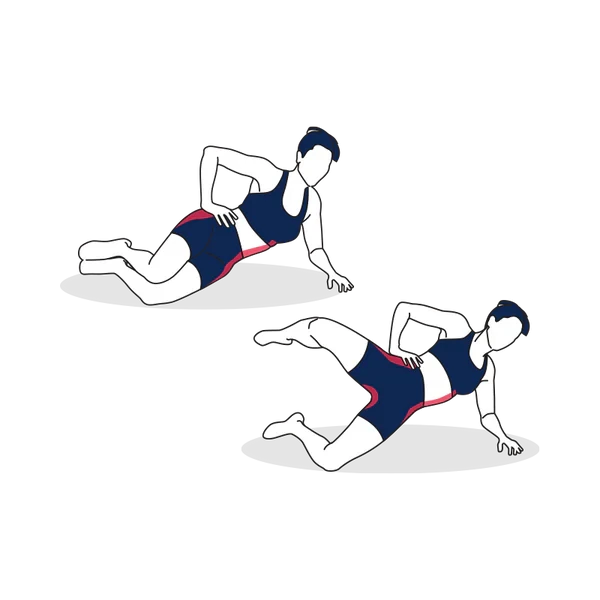
Exercise Description
Lie on your side, legs stacked. Prop up on your elbow aligned under your shoulder. Engage your core and raise your hips to form a straight line, hold briefly, then lower with control and repeat.
How To Perform
Lie on your side with your legs stacked and your forearm on the floor, elbow directly under your shoulder.
Brace your core, keep your body in one line, and drive your hips upward until your head, torso, and legs form a straight line.
Hold the top position briefly while keeping hips square and ribs down.
Lower your hips back to the floor under control and repeat for the prescribed reps before switching sides.
Expert Tips
Maintain alignment - Keep the elbow under the shoulder and the body in one straight line to protect the shoulder and load the core.
Avoid hip sag and twisting - Keep the hips lifted and square to the wall in front of you to maximize oblique and glute engagement.
Scale intelligently - Beginners can bend the knees for more stability; advanced lifters can add a light band above the knees.
Emphasize control - Prioritize form over speed and consider adding a side plank hold at the top for extra time under tension.
Common Mistakes
Letting the hips sag - Reduces core activation and places stress on the lower back.
Twisting the torso - Rotating through the shoulders or pelvis shifts tension away from the obliques.
Poor shoulder position - Not stacking the elbow under the shoulder decreases stability and can cause discomfort.
Rushing the reps - Using momentum instead of controlled movement limits muscle engagement.
Info – Side Lying Hip Raise
The Side Lying Hip Raise targets the obliques, glutes, and core. Common mistakes include letting the hips sag or twisting the torso. Keep the body aligned and the core engaged. Beginners can bend the knees for more stability, while advanced lifters can add a resistance band around the thighs. Prioritize form over speed to prevent injury. For added variety, incorporate a side plank hold at the top of the movement.
Equipment Required
No equipment needed.