DUMBBELL STEP UP
Lower Body Strength and Balance
Primary Muscles
Exercise Description
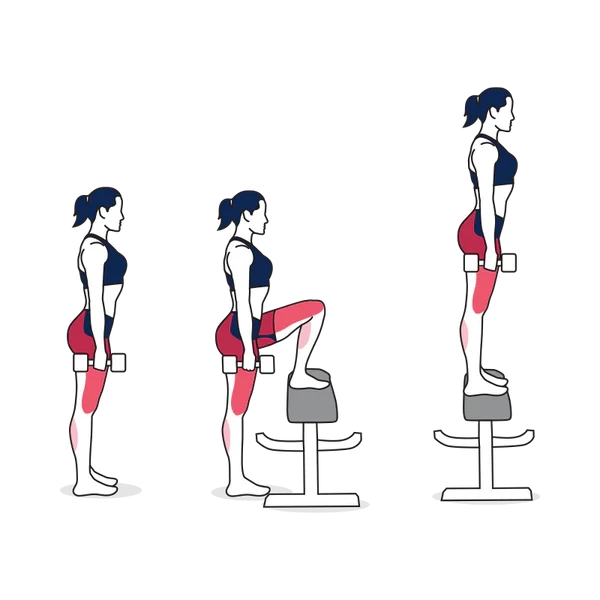
Stand in front of a bench with a dumbbell in each hand. Step up with one foot, press through the heel, and bring the other foot up. Step down and repeat, keeping your back straight.
How To Perform
Stand facing a sturdy step or bench, holding a dumbbell in each hand at your sides with a neutral grip.
Place your entire right foot on the step. Brace your core and keep your chest tall.
Press through the heel of the front foot to drive your body up, bringing the left foot onto the step to stand tall.
Pause briefly at the top with hips and knees fully extended without leaning forward.
Step down under control with the trailing foot first, then return the lead foot to the floor.
Repeat all reps on one leg or alternate legs, maintaining an upright torso throughout.
Expert Tips
Choose an appropriate step height - Use a height that challenges you while allowing strict form; your front thigh should reach roughly parallel at the bottom.
Keep posture upright - Avoid excessive forward lean or using momentum; move with control and keep shoulders stacked over hips.
Drive through the heel - Ensure the entire foot is on the step and push primarily through the heel for better glute and quad activation.
Manage load and tempo - Start with bodyweight or light dumbbells; increase load or add a knee lift/slow eccentric as you progress.
Common Mistakes
Leaning forward and using momentum - This reduces muscle engagement and can stress the lower back; keep the torso upright and move deliberately.
Partial foot on the step - Placing only the toes increases instability; ensure the whole foot is planted to protect the knee and ankle.
Letting the knee cave inward - Track the knee over the toes to maintain alignment and reduce joint stress.
Info – Dumbbell Step Up
The dumbbell step up targets the quadriceps, hamstrings, and glutes while challenging balance and core stability. Choose a step height that allows good mechanics without compromising posture. Maintain an upright torso and move with control rather than momentum. Beginners can use bodyweight or lighter dumbbells; advanced lifters may increase the load or add a knee lift at the top for added difficulty.
Ensure your entire foot is on the step and drive through the heel. Adjust tempo to emphasize either strength (slower eccentric) or power (faster concentric) depending on your goal.
Equipment Required
Dumbbells, step or bench.