Chest exercise guide
Pec Deck Machine
What it does for your chest, and how to set it up and use it well.
The pec deck is the easiest way to isolate your chest. The machine sets the path, so you can focus on the squeeze, the stretch and pushing the set hard.

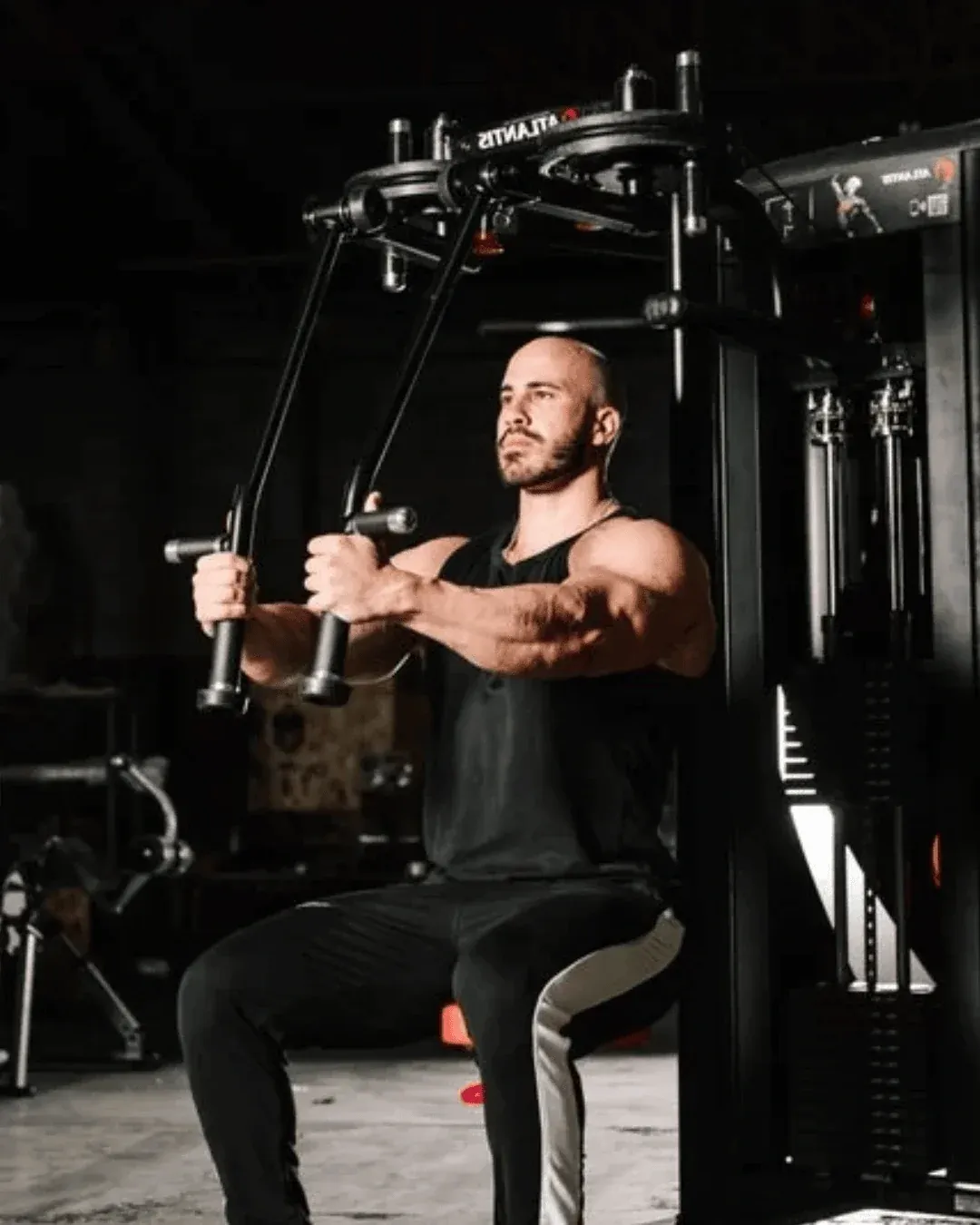
The pec deck is a seated chest machine that works like a fly. Sit with your back on the pad and elbows slightly bent at about shoulder height, then bring the handles or arm pads together in front of your chest. Its main benefit is simple chest isolation on a fixed path that is safe to push hard.
Key takeaways
- The pec deck isolates the chest. The front shoulders help; the triceps barely work.
- Set the seat so your hands or elbows sit at about shoulder height, or slightly below.
- Keep a slight, fixed bend in the elbows and control the return. No momentum.
- The fixed path makes it a good choice for beginners and for hard sets without a spotter.
- 2 to 4 sets of 10 to 15 reps after your presses suits most people.
- Muscles
- Chest (pectoralis major), front shoulders
- Equipment
- Pec deck / pec fly machine
- Difficulty
- Beginner
- Sets & reps
- 2–4 sets of 10–15 reps
Why do it
Benefits of the Pec Deck
- 01
Chest isolation
The arms move in an arc, so the chest does the work and the triceps do not limit the set.
- 02
A fixed path
The machine guides your arms. There is less to balance, so it is easy to learn and repeat.
- 03
Safe to push hard
You can train close to failure without a spotter. If a rep fails, the handles just go back.
- 04
Tension at the squeeze
Unlike a dumbbell fly, the machine keeps resisting when your hands meet in front.
- 05
Quick to adjust
Pin-loaded stacks make it easy to drop the weight for an extra set.
"I use the pec deck as the last chest exercise of a session. Presses are done, the shoulders are tired, and the machine lets me finish the chest safely."
Herman Leir, Personal Trainer
Anatomy
What Muscles Does the Pec Deck Work?
The pec deck mainly works the pectoralis major, the large chest muscle. The front shoulders (anterior deltoids) help bring the arms forward. The triceps do very little, because your elbow angle does not change.
The same machine often turns around into a reverse pec deck for the rear shoulders. That is a different exercise, facing the pad.
Step by step
How to Use the Pec Deck
- 01
Set the seat
Adjust the seat so the handles, or the middle of the arm pads, sit at about shoulder height. Slightly below is fine. Not much lower.
- 02
Set the start
If the machine has a range setting, start with the arms just behind your body, at a stretch you can control.
- 03
Sit tall
Back flat against the pad, a slight arch in your lower back is fine. Chest up, head looking straight ahead.
- 04
Warm up
Do one or two light sets first.
- 05
Bring the arms together
Breathe out and squeeze the handles or pads together in front of your chest, like a hug. Keep a slight bend in the elbows.
- 06
Pause
Hold the squeeze for a second.
- 07
Return slowly
Breathe in and let the arms open for 2 to 3 seconds until you feel a stretch. Do not let the weight pull you back. A deep stretch is useful if it does not hurt.
Get it right
Form Cues
Do
- Chest up the whole set. Keep it lifted so the chest, not the shoulders, does the work.
- Elbows at shoulder height. Too low and the shoulders take over.
- Slow and steady. No momentum in either direction.
- Shoulder blades on the pad. Do not let them roll forward as the arms meet.
- Rest at least a minute between sets.
Common mistakes
- Seat too low or too high. Elbows well below the shoulders shift the work to the front shoulders. Re-set the seat.
- Too big a stretch. Starting with the arms pulled far behind you strains the front of the shoulder. Set a range you control.
- Using momentum. Slamming the pads together and letting them fly back skips the hardest part of the rep.
- Leaning forward. Coming off the back pad turns it into a push. Stay against the pad.
- Going too heavy. If you cannot pause at the squeeze, the weight is too heavy.
Programming
Sets and Reps for the Pec Deck
Pick a weight you can bring together with a one-second squeeze and lower slowly, and finish each set with 1 to 3 reps left. Because the machine is stable, it is a good place to take the last set close to failure.
| Goal | Sets | Reps | Rest |
|---|---|---|---|
| Learning the machine | 2 | 12–15 (light) | 60 s |
| Muscle growth | 2–4 | 10–15 | 60–90 s |
Use it after your presses. For weekly set counts, see how much you should train.
Fly options
Pec Deck vs Cable Crossover vs Dumbbell Fly
All three are chest flies. The difference is how stable they are and where the tension sits.
| Feature | Pec deck | Cable crossover | Dumbbell fly |
|---|---|---|---|
| Stability | Highest | Medium | Lowest |
| Tension at the squeeze | Yes | Yes | Low |
| Adjustable angle | No | Yes | With an incline bench |
| Easiest to learn | Yes | Medium | Medium |
Want to change the angle? Use the cable crossover. No machine? The dumbbell fly does the same job with a bench. For pressing with a machine, see the chest press machine. And keep a press as the base of your chest training, such as the barbell bench press. Full ranking: the best chest exercises.
Fit
Who It's For, and Who Should Skip It
Good fit: beginners learning to feel the chest work, lifters who want an isolation finisher after presses, and anyone training without a spotter.
Skip it or swap it if: the stretch causes shoulder pain even with a shorter range. Try a cable crossover at mid-height or a lighter dumbbell fly. Stop if you feel sharp pain. The pec deck is a supplement, not a full chest workout. Pair it with a press.
Questions
Frequently Asked Questions
What are the benefits of the pec deck?
The pec deck isolates the chest on a fixed path, so it is easy to learn and the triceps do not limit the set. It keeps tension when your arms meet in front, which dumbbell flies do not. It is also safe to push close to failure without a spotter, because a failed rep simply returns the handles. That makes it a good finisher after presses.
What muscles does the pec deck work?
The pec deck mainly works the pectoralis major, the large muscle across your chest. The front shoulders help bring your arms forward. Your triceps do very little, because the elbow angle stays the same through the rep. Turned around, many machines also do the reverse pec deck, which works the rear shoulders and upper back instead of the chest.
Is the pec deck as good as the bench press?
No, they do different jobs. The bench press is a compound lift that lets you load the chest, shoulders and triceps heavy, which builds strength and size. The pec deck isolates the chest with lighter weight. Use a press as the base of your chest training and the pec deck as an addition. Either alone covers less than both together.
How high should the seat be on a pec deck?
Set the seat so the handles, or the middle of the arm pads, sit at about shoulder height when you sit tall. Slightly below shoulder height is fine. Much lower, and the front shoulders start to take over the movement. If your shoulders feel pinched at the stretch, raise the seat a notch or shorten the starting range.
Is the pec deck good for beginners?
Yes. It is one of the easiest chest exercises to learn, because the machine sets the path and there is nothing to balance. Beginners can use it to learn what the chest feels like when it works. Start light, keep the elbows at shoulder height and control the return. Learn a press as well, such as the push-up or bench press.
HermQ programs
Train your chest with a plan.
Want the pec deck inside a full chest plan? One subscription unlocks every HermQ bodybuilding program. Billed monthly.
60-day money-back guarantee.
Want a coach instead?
Get 1:1 Coaching