Chest exercise guide
Cable Crossover
Pulley heights, form, and which version trains which part of the chest
The cable crossover keeps tension on your chest from the stretch to the squeeze. Change the pulley height and you change which part of the chest works hardest.

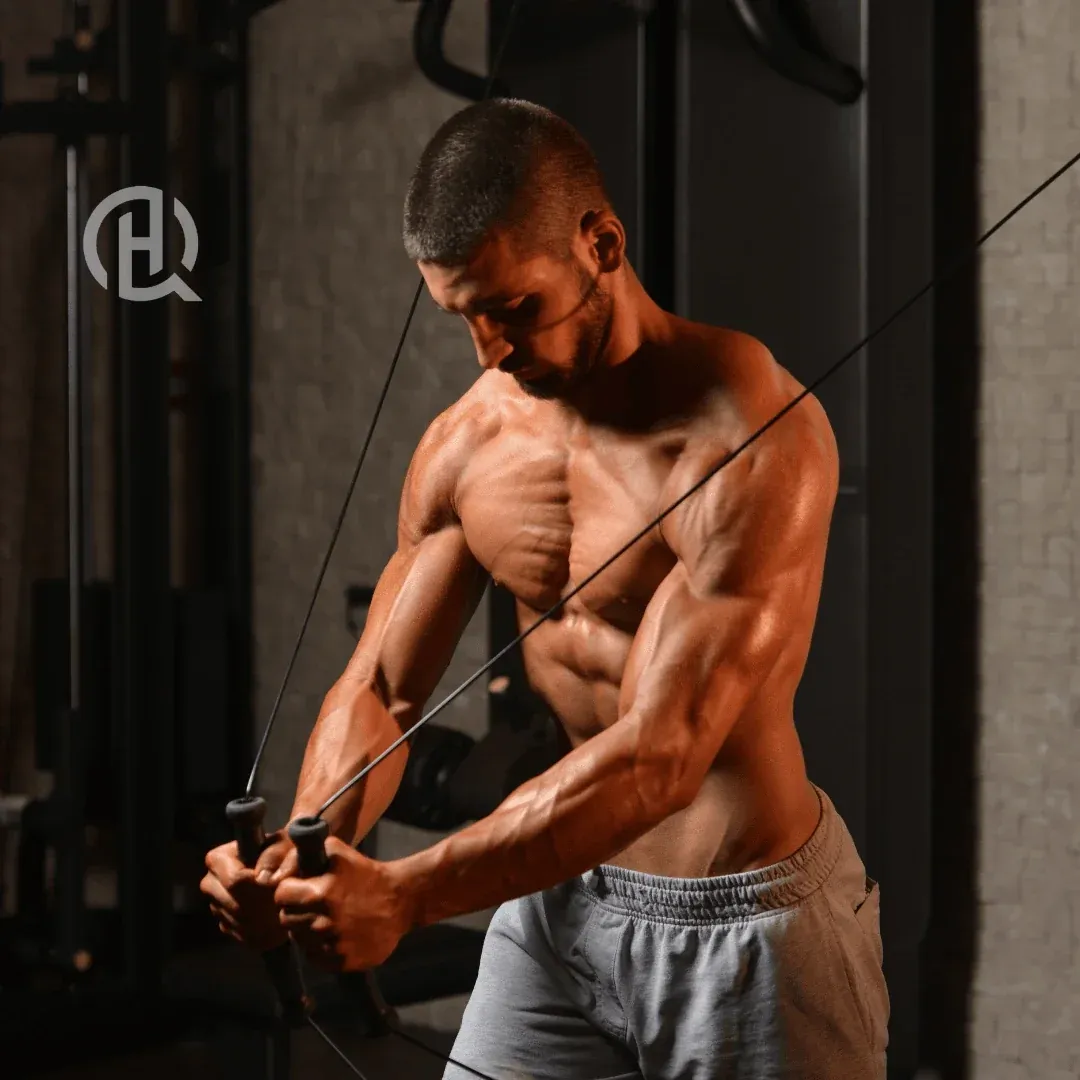
The cable crossover is a chest isolation exercise done at a cable station. Stand between two pulleys, lean slightly forward, and with your elbows slightly bent, bring the handles together in front of your chest in a wide arc. The pulley height decides the focus: high pulleys for the lower chest, low pulleys for the upper chest.
Key takeaways
- High-to-low works the lower chest, mid-height the middle, low-to-high the upper chest.
- Keep a slight, fixed bend in the elbows. The movement is a hug, not a press.
- Breathe out as the handles come together, in as they go back.
- Cables keep tension where dumbbells lose it, at the squeeze.
- Go moderate: 2 to 4 sets of 10 to 15 reps after your presses.
- Muscles
- Chest (pectoralis major), front shoulders
- Equipment
- Cable crossover station, two D-handles
- Difficulty
- Beginner to intermediate
- Sets & reps
- 2–4 × 10–15
The basics
What Is the Cable Crossover?
The cable crossover, also called the cable fly, is a fly done with two cable pulleys. Your arms sweep in an arc and meet in front of your body, so the chest does the work and the triceps barely help.
What you need: a cable crossover station (two adjustable pulleys facing each other) and two D-handles. Most gyms have one.
Benefits
- 01
Tension through the whole rep
Cables pull from the side, so the chest stays loaded at the squeeze, where dumbbell flies go slack.
- 02
Adjustable angle
Move the pulleys to shift the work toward the upper, middle or lower chest.
- 03
Easy on the joints
Light, smooth resistance with a natural arm path.
- 04
A strong finisher
Easy to set up after presses, and easy to drop the weight for extra sets.
Step by step
How to Do the Cable Crossover
- 01
Warm up
Do one light set of crossovers before your working sets.
- 02
Set the pulleys
For the standard version, set both pulleys above head height. Both sides at the same notch.
- 03
Grab the handles
Take one handle in each hand and step forward to the middle of the station so the cables are tight.
- 04
Set your stance
One foot slightly in front of the other, knees soft. Lean slightly forward from the hips with your chest up.
- 05
Set the elbows
Arms out to the sides, elbows slightly bent. Keep that bend all set.
- 06
Bring the handles together
Breathe out and sweep the handles down and in, in an arc, until they meet in front of your lower chest. Pause for a second and squeeze.
- 07
Return slowly
Breathe in and let your arms open back along the same arc for 2 to 3 seconds, until you feel a stretch across the chest. Stop before your shoulders get pulled behind you.
"The pause at the front is the part most people skip, and it is where the cable earns its place over dumbbells."
Herman Leir, Personal Trainer
Variations
Which Pulley Height Should You Use?
The direction your arms move decides which part of the chest works hardest. Pull in the direction the chest fibres you want to train run.
| Version | Pulley position | Hands finish | Main emphasis |
|---|---|---|---|
| High-to-low | Above head height | In front of the lower chest or hips | Lower chest |
| Mid-height | About shoulder height | In front of the middle chest | Middle chest |
| Low-to-high | Near the floor | In front of the upper chest or chin | Upper chest |
Other variations
- Single-arm cable crossover: one side at a time. Lets you focus on a weaker side and cross slightly past the midline.
- Bench cable fly: a flat or incline bench placed between the pulleys. More stable, closer to a dumbbell fly with constant tension.
Get it right
Form Cues
Five cues that keep the work on your chest, and the five mistakes that take it away.
Do
- Hug, don't press. Arms sweep in an arc. If the elbows bend more on the way in, it has become a press.
- Chest up. Lean from the hips, not by rounding your back.
- Same speed both sides. The handles meet in the middle at the same time.
- Squeeze, then stretch. A short pause at the front and a slow return.
- Stay still. Your body stays where it is. Only the arms move.
Common mistakes
- Slack cables. If you stand too close, the cable goes slack at the stretch. The load becomes uneven and the handle can snap back. Step forward until the cables stay tight.
- Too much weight. If you cannot move smoothly and under control, lower the weight. Heavy crossovers turn into a lean-and-yank.
- Pressing the handles. Bending the elbows to push the handles forward moves the work to the triceps.
- Overstretching. Letting the cables pull your arms far behind your body strains the front of the shoulder.
- Rocking. Using your body weight to start each rep takes the work off the chest. Brace and stay still.
Programming
Sets and Reps for the Cable Crossover
Pick a weight you can move smoothly with a one-second squeeze at the front, and finish each set with 1 to 3 reps left. Cable stacks jump in big steps, so add reps before you add weight.
| Goal | Sets | Reps | Rest |
|---|---|---|---|
| Learning the movement | 2 | 12–15 (light) | 60 s |
| Muscle growth | 2–4 | 10–15 | 60–90 s |
Do it after your presses, as a finisher.
Swap it
Cable Crossover Alternatives
Pec deck
A machine fly with a fixed path. The easiest isolation exercise to learn. See pec deck machine.
Dumbbell fly
No cables needed. More stretch at the bottom, less tension at the top. See the dumbbell fly guide.
Barbell bench press
A compound press that also works the shoulders and triceps. Build your chest training around it. See flat barbell bench press.
Incline dumbbell bench press
A press for the upper chest, and a good first exercise in a chest workout. See incline dumbbell bench press.
Where the crossover ranks: the best chest exercises.
Questions
Frequently Asked Questions
What muscles does the cable crossover work?
The cable crossover mainly works the chest, the pectoralis major. The front shoulders help move the arms, and the biceps and core work to hold your position. The pulley height changes the focus within the chest: a high pulley moving down puts more work on the lower chest, and a low pulley moving up puts more on the upper chest.
Is cable crossover high to low or low to high better?
Neither is better overall. They train different parts of the chest. High-to-low emphasises the lower chest, and low-to-high emphasises the upper chest. If your upper chest lags, which is common, start with low-to-high. If you want to train the whole chest over a week, use both, either in the same session or on different days.
Is the cable crossover better than the dumbbell fly?
They do slightly different jobs. Dumbbell flies load the chest hardest in the stretch and lose tension at the top. Cables keep tension through the whole rep, including the squeeze, and let you change the angle. Many lifters use cables as a finisher and dumbbell flies for stretch. If your gym has cables, the crossover is often the easier one to do well.
Should you cross your hands on a cable crossover?
You can, but you do not have to. Bringing the handles together in front of you is enough for most people. Crossing one hand slightly past the other, alternating each rep, adds a little extra range at the squeeze. Do it only if you can keep your elbows slightly bent and your body still. Single-arm crossovers make crossing the midline easier.
Is the cable crossover good for beginners?
Yes, with light weight. The movement is simple and the cables are easy to adjust in small steps. Beginners should start with the mid-height version, which is the easiest to learn, and focus on a fixed elbow bend and a slow return. Learn a basic press such as the push-up or bench press too, because the crossover alone will not build a strong chest.
HermQ programs
Train your chest with a plan.
Want the crossover inside a full chest plan? One subscription unlocks every HermQ bodybuilding program. Billed monthly.