Chest exercise guide
Dumbbell Fly
How to do the flat dumbbell chest fly, and how to keep your shoulders happy.
The dumbbell fly is the simplest way to stretch and isolate your chest with free weights. Done right it is light, slow and easy on the shoulders.

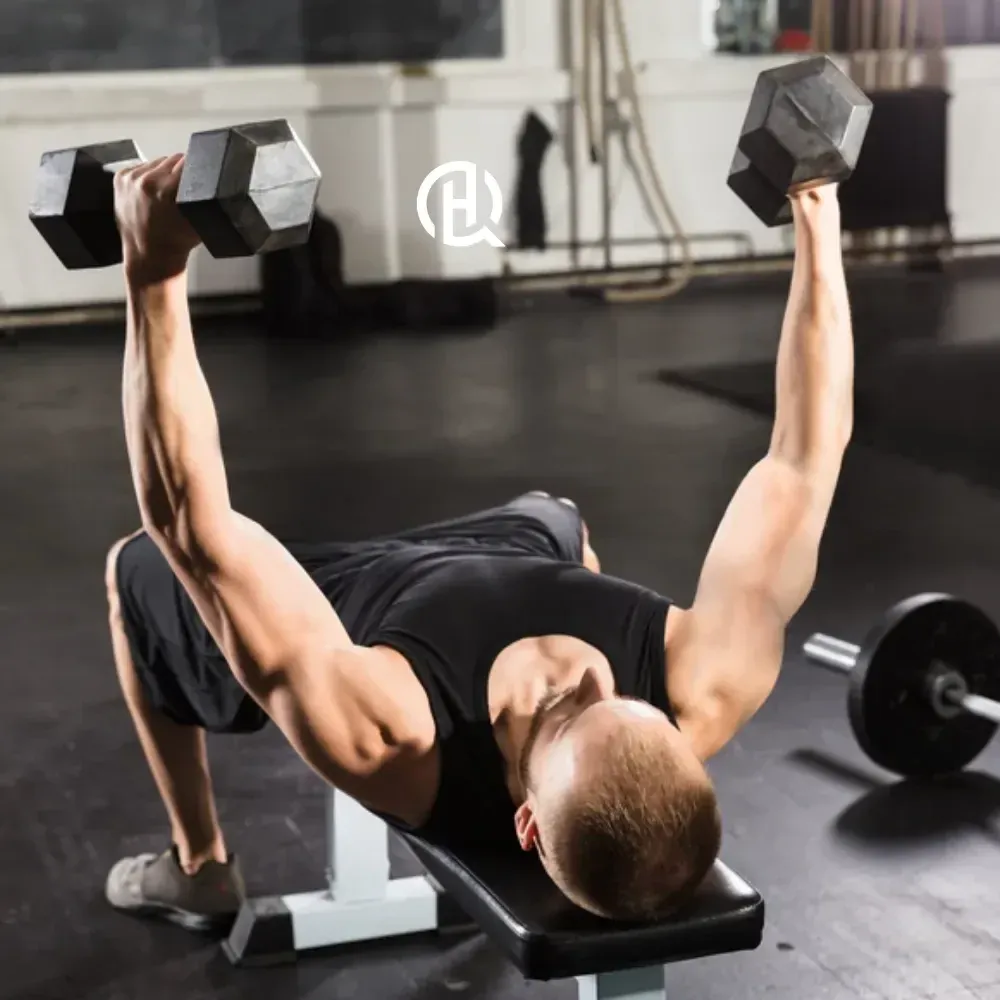
The dumbbell fly is a chest isolation exercise. Lie on a flat bench with a dumbbell in each hand above your chest, elbows slightly bent. Open your arms in a wide arc until you feel a stretch at about chest level, then bring the dumbbells back together. It mainly works the pecs, with help from the front shoulders.
Key takeaways
- It is an arc, not a press. The elbow bend stays the same through every rep.
- Lower until you feel a stretch at about chest level, not as far as your arms will go.
- Go light. A weight you can control for 10 to 15 reps works better than a heavy one.
- Use it after your presses, as a finisher, for 2 to 4 sets.
- Shoulder discomfort usually means too deep, too heavy or straight elbows.
- Muscles
- Chest (pectoralis major), front shoulders, biceps as stabilisers
- Equipment
- Flat bench, two dumbbells
- Difficulty
- Beginner to intermediate
- Sets & reps
- 2–4 × 10–15
The basics
What is the dumbbell fly?
The dumbbell fly is a chest exercise where your arms move in a wide arc, like hugging a big tree. Unlike a press, your elbows barely change angle, so your triceps do almost nothing. That puts the work on the chest.
The pecs (pectoralis major) do most of the work, the front shoulders assist, and the biceps help hold the elbow angle.
Why do it
Dumbbell fly benefits
- 01
Stretch under load
The chest works hardest at the bottom, where it is stretched.
- 02
Chest without the triceps
Your triceps are not the limit, so you can work the chest after presses have tired your arms.
- 03
Simple equipment
A bench and a pair of light dumbbells.
- !
One limit to know
At the top, with the dumbbells stacked over your chest, the tension drops. Cables and the pec deck keep tension there. Many lifters use both.
Step by step
How to do the dumbbell fly
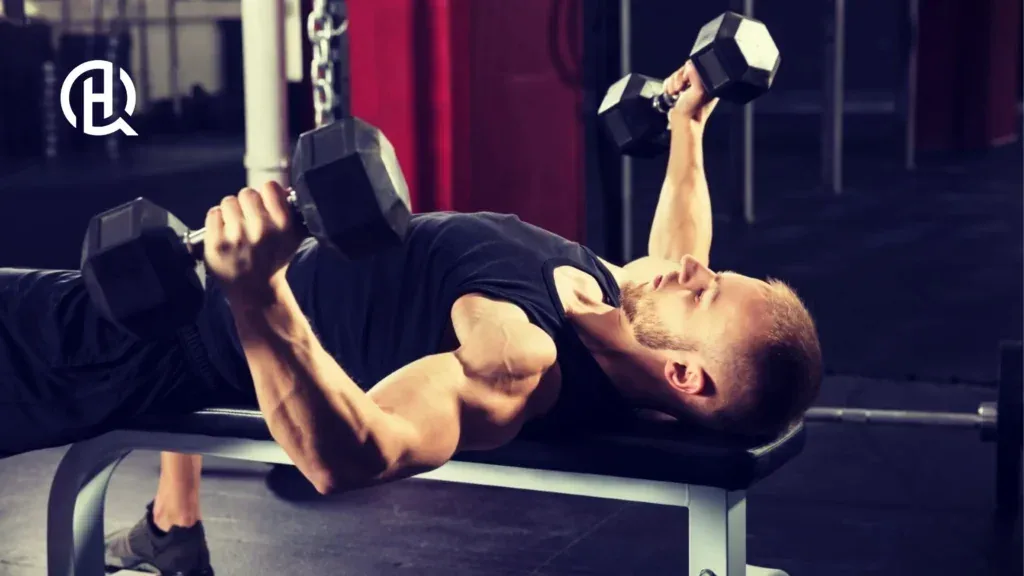
- 01
Warm up
If the fly is your first chest exercise, do 1 to 2 easy sets with very light dumbbells first. If you have already pressed, one light set is enough.
- 02
Set up
Sit on a flat bench with the dumbbells on your thighs. Lie back and press them up over your chest. Feet flat on the floor, shoulder blades pulled back and down.
- 03
Set the elbows
Turn your palms to face each other and bend your elbows slightly. Hold that bend for the whole set.
- 04
Lower in an arc
Open your arms out to the sides for 2 to 3 seconds. Breathe in.
- 05
Stop at the stretch
Stop when the dumbbells reach about chest level and you feel a stretch across the chest. If your shoulders feel pinched, stop higher.
- 06
Bring them back
Breathe out and squeeze the dumbbells back up along the same arc until they meet over your chest. No clanging.
- 07
Finish
After the last rep, bring the dumbbells to your chest and sit up with them on your thighs.
Get it right
Form cues
Five cues that keep the work on your chest, and the mistakes that move it to your shoulders.
Do
- Hug a tree. Think of the movement as wrapping your arms around something big.
- Fixed elbows. If your elbows bend more on the way up, it has become a press. Lighten the weight.
- Chest up, shoulders back. Keep the shoulder blades pinned so the shoulders do not roll forward.
- Brace. Tighten your core so your body does not rock on the bench.
- Slow down. Control the lowering every rep.
Common mistakes
- Going too deep. Dropping the dumbbells below the bench line puts the shoulder joint, not the chest, under strain.
- Locking the elbows straight. Straight arms load the elbow and the front of the shoulder. Keep the slight bend.
- Turning it into a press. Bending and straightening the elbows moves the work to the triceps.
- Using too much weight. If you cannot control the bottom of the rep, the dumbbells are too heavy.
- Rushing. Fast reps skip the stretch, which is the point of the exercise.
Swap options
Dumbbell fly variations and alternatives
Incline dumbbell fly
The same move on a bench set around 30 degrees. More upper-chest work. See the incline dumbbell fly guide for the angle and the flat-vs-incline comparison.
Cable crossover
Keeps tension at the top where dumbbells lose it. See cable crossover.
Pec deck
A machine fly with a fixed path. The easiest to learn. See pec deck machine.
Floor fly
Lying on the floor limits how deep you can go. A good start if deep stretches bother your shoulders.
Presses instead
If you want strength more than isolation, use a dumbbell bench press. Short of equipment? Push-ups train the chest, shoulders and triceps.
Where the fly ranks against other chest moves: the best chest exercises.
Programming
How heavy should dumbbell flies be? Sets and reps
There is no formula, and form comes first. Pick a weight you can lower slowly to a full stretch for every rep, and finish each set with 1 to 3 reps left. For most people that is far lighter than their dumbbell press. Add weight only when every set reaches the top of the rep range with the same form.
| Goal | Sets | Reps | Rest |
|---|---|---|---|
| Learning the movement | 2 | 12–15 (very light) | 60 s |
| Muscle growth | 2–4 | 10–15 | 60–90 s |
Do it after your main presses. One or two fly-type exercises per chest session is plenty. For weekly set counts, see how much you should train.
Fit
Who it's for, and who should skip it
Good fit: anyone training for a bigger chest who wants an isolation exercise with just a bench and dumbbells. Beginners can learn it with very light weights.
Skip it or swap it if: deep stretches cause shoulder pain. Try a floor fly or the pec deck, which limit depth. Stop if you feel sharp pain in the shoulder or chest.
Questions
Dumbbell fly FAQ
Short answers to what lifters ask most about flies.
Are dumbbell flies good for building chest?
Yes, as an addition to pressing. Flies stretch the chest under load and work it without your triceps setting the limit, which makes them a good finisher after presses. On their own they are not enough, because you cannot load them heavy. A bench press or dumbbell press builds the base, and one or two sets of flies afterwards round it out.
Is a fly or a press better for chest?
For most people, a press is the base and the fly is the extra. Presses let you lift heavier and train the chest, shoulders and triceps together, which suits size and strength. Flies isolate the chest and stretch it, which suits a finisher. If you only have time for one, choose a press. If you have time for two, add a fly.
How heavy should dumbbell flies be?
Light enough to lower slowly to a full stretch and bring back up without bending your elbows more. For most lifters that is much lighter than the dumbbells they press with. Aim for 10 to 15 controlled reps with one to three left in the tank. If the dumbbells pull your arms down at the bottom, they are too heavy.
Should the dumbbells touch at the top of a fly?
They can meet, but do not bang them together. At the top, the dumbbells stack over your chest and the tension drops, so there is little to gain from squeezing them hard. Stop just short of touching, or let them meet lightly, then start the next rep. The work happens in the stretch at the bottom, not the clash at the top.
Are dumbbell flies bad for your shoulders?
Not when done with light weight, a slight elbow bend and a stretch that stops at about chest level. Most shoulder pain comes from going too deep, locking the elbows or using too much weight. If flies still bother you after fixing those, try a floor fly, which limits depth, or the pec deck. Stop if you feel sharp pain.
HermQ programs
Train your chest with a plan.
Want flies placed in a full chest plan? One subscription unlocks every HermQ bodybuilding program. Billed monthly.