Chest exercise guide
Dumbbell Bench Press
How to set up, press and progress the flat dumbbell press
The dumbbell bench press works the same muscles as the barbell version, with more range and each arm on its own. This is how to do it well.

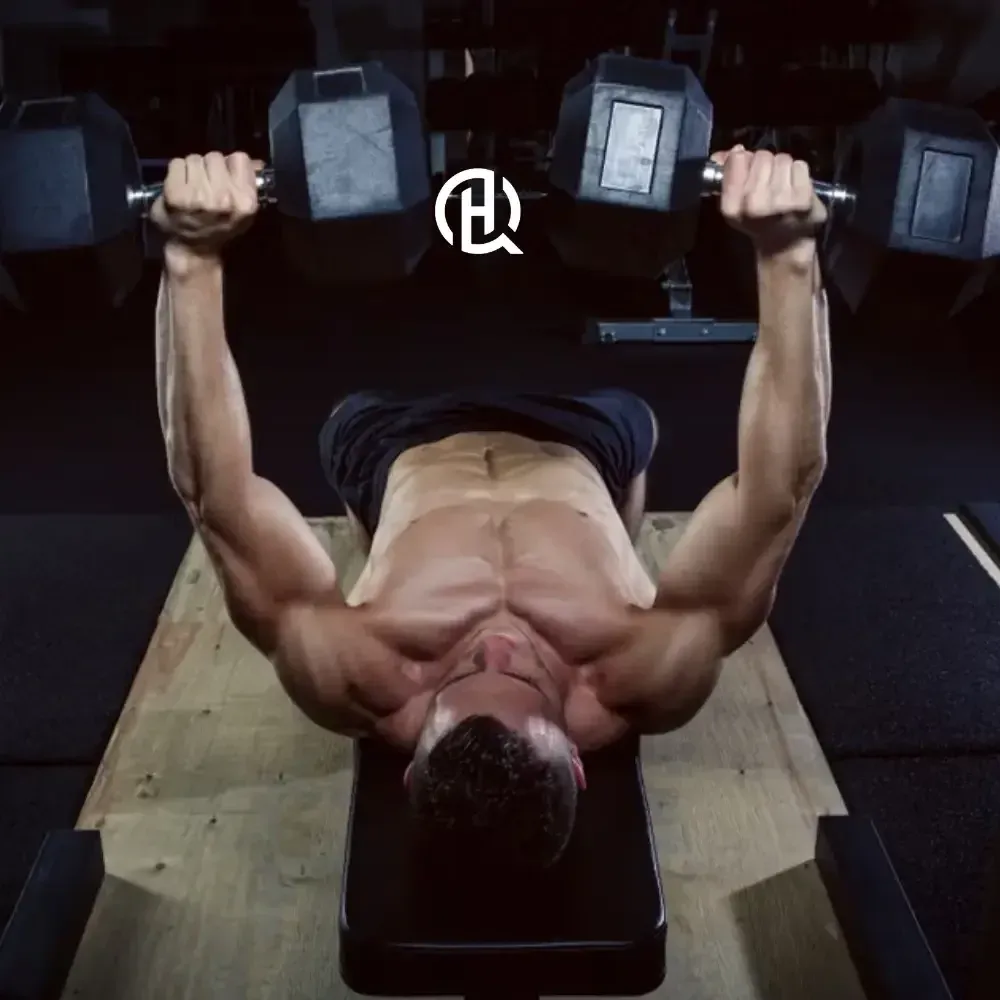
The dumbbell bench press is a flat-bench chest press with a dumbbell in each hand. It works the chest, front delts and triceps, like the barbell bench press, but gives you a deeper stretch and makes each arm work on its own. Lower the dumbbells with control to chest level, then press up and slightly in. It is #2 in our list of the best chest exercises.
Key takeaways
- Works the chest, front delts and triceps, with more range of motion than a barbell.
- Each arm works alone, so a weaker side cannot hide.
- Get the dumbbells into position by kicking them up from your thighs, and lower them back the same way.
- Elbows about 45° from your torso, wrists straight, shoulder blades pulled back.
- Expect to lift less total weight than on the barbell. That is normal.
- Fighters: a neutral-grip or single-arm version trains each arm alone and is often more comfortable for shoulders that do a lot of punching.
- Muscles
- Chest, front delts, triceps
- Equipment
- Pair of dumbbells, flat bench
- Difficulty
- Beginner to advanced
- Sets & reps
- Strength 3–4 × 5–8 · Size 3–4 × 8–12
Step by step
How to do the dumbbell bench press
- 01
Sit with the dumbbells
Sit on the end of a flat bench with a dumbbell standing on each thigh.
- 02
Kick them up
Lie back and use your knees to kick the dumbbells up to your chest as your back reaches the bench.
- 03
Set your base
Plant your feet flat on the floor. Pull your shoulder blades back and down. Do not over-arch your lower back.
- 04
Press to the start
Press the dumbbells up over your chest, palms facing your feet.
- 05
Lower with control
Breathe in and lower the dumbbells slowly, elbows about 45° from your torso, until you feel a stretch across your chest. For most people that is around chest level.
- 06
Press up and in
Press back up and slightly in, so the dumbbells finish close together over your chest. Breathe out near the top.
- 07
Sit back up
After the last rep, bring the dumbbells to your chest, tuck your knees up, and use the momentum to sit up with the dumbbells back on your thighs.
Get it right
Form cues
Do
- Wrists straight. Stack them over your elbows. A small bend is fine if it does not hurt; a wrist folded back is not.
- Control the way down. Take about 2 seconds to lower. The stretch at the bottom is where dumbbells beat the barbell.
- Shoulder blades pinned. Keep them back and down for the whole set.
- Feet planted, core tight. It keeps your body still so the chest does the work.
- Breathing. Breathe in on the way down, brace, and breathe out as you press. Some lifters prefer to breathe at the top between reps. Either works if you stay braced during the rep.
Common mistakes
- Dropping the dumbbells to the floor from the bottom position. It is hard on your shoulders and dangerous for people nearby. Bring them to your chest and sit up, or lower them to your sides with control.
- Flaring the elbows straight out. It loads the front of the shoulder. Keep about 45°.
- Going too deep. A bigger stretch is good only while your shoulders stay pinned and pain-free.
- Clanking the dumbbells at the top. It takes tension off the chest. Stop just before they touch.
- Picking dumbbells you cannot get into position. If the kick-up is a struggle, the weight is too heavy for now.
Compare
Dumbbell vs barbell bench press
| Feature | Dumbbell bench press | Barbell bench press |
|---|---|---|
| Range of motion | Deeper stretch, hands can come together at the top | Bar stops at the chest |
| Load | Less total weight | Most weight of any chest press |
| Each side | Works alone, shows imbalances | Stronger side can help |
| Shoulders | Free path, easier to find a comfortable angle | Fixed hand position |
| Safety | Easier to bail without a rack, but use a spotter on heavy sets | Use a spotter or safety arms |
Both build the chest. Use the barbell for heavy strength work and dumbbells for range and balance. Many lifters do both in a week. More on the barbell version in bench press benefits.
Flat vs incline dumbbell press
Both work the whole chest. The flat press spreads the work across it; an incline around 30° shifts more of it to the upper chest and front delts. For the incline version, see how to do the incline dumbbell bench press.
Swap options
Variations
Neutral-grip dumbbell press
Palms facing each other. Often easier on the shoulders and uses more triceps.
Single-arm dumbbell press
One dumbbell at a time. Your core has to stop you rolling off the bench.
Incline dumbbell bench press
More upper chest. See the incline dumbbell bench press guide.
Dumbbell decline bench press
More lower chest. See the dumbbell decline bench press guide.
Dumbbell fly
Same position, arms stay nearly straight for a pure chest stretch. See the dumbbell fly guide.
Programming
Sets and reps by goal
| Goal | Sets × reps | Rest |
|---|---|---|
| Strength | 3–4 × 5–8 | 2–3 min |
| Muscle growth | 3–4 × 8–12 | 1.5–2 min |
| Beginner / technique | 2–3 × 10–12, light | 1–1.5 min |
General guidance.
Warm up with 2–3 lighter sets of the same exercise. Add weight when you reach the top of the range on every set. Dumbbells go up in bigger relative jumps, so add reps first, then weight.
"I like dumbbells as the second press of a chest day. After a heavy barbell set the shoulders are warm, and the dumbbells let the chest work through a full stretch."
Herman Leir, Personal Trainer
Who it's for, and who should skip it
- Good for: beginners learning to press, lifters with a weaker side, anyone whose shoulders feel better with a free hand path, home gyms with dumbbells and a bench.
- Adjust if: your shoulders hurt at the bottom. Shorten the range, try a neutral grip, or use the chest press machine. Stop if the pain is sharp.
- Skip for now if: you cannot safely get the dumbbells into position. Start with push-ups or the chest press machine.
For fighters
Dumbbell bench press for fighters
If you train Muay Thai, boxing or MMA, the dumbbell press has one clear plus: each arm works on its own. A stronger side cannot cover for a weaker one, so you see the gap and can close it. The pressing strength helps you hold a frame and push an opponent away. It is not where punch power comes from. That is mostly your legs, hips and trunk.
Dumbbells also let you choose the hand path. A neutral grip, palms facing each other, is often the most comfortable option for shoulders that already handle a lot of pad work.
When
Use it as your main press on a lighter day, or a few hours away from hard sparring.
How much
Two or three sets of 6–10 reps, each stopped 1–3 reps short of failure, is enough. Drop sets as a fight gets close.
Trunk work
For more trunk work, try the single-arm version: your core has to stop you rolling off the bench.
Questions
Dumbbell bench press: FAQ
What muscles does the dumbbell bench press work?
The dumbbell bench press works the chest (pectoralis major) as the main mover, with the front delts and triceps helping. Because each arm works on its own, smaller stabilising muscles around the shoulders also work harder than on a barbell. Your core and upper back keep you steady on the bench.
Is the dumbbell bench press better than the barbell bench press?
Neither is better for everyone. The barbell lets you lift more, so it is the stronger choice for pure strength. Dumbbells give a deeper stretch, let each arm work alone and are often easier on the shoulders. For chest growth both work well. Many lifters use the barbell first in a session and dumbbells second.
How do you get heavy dumbbells into position?
Sit on the end of the bench with the dumbbells standing on your thighs. As you lie back, drive one knee and then the other up to kick each dumbbell to your chest. Press them up once your back is set. To finish, lower them to your chest and reverse the move to sit up. Ask a spotter to hand them to you on very heavy sets.
How low should you go on a dumbbell bench press?
Lower until you feel a strong stretch across your chest while your shoulder blades stay pinned back. For most people that is with the dumbbells around chest level. Going lower only helps if your shoulders stay comfortable. If you feel a pinch at the front of the shoulder, stop a little higher.
Why can I lift less with dumbbells than with a barbell?
Each arm has to balance its own weight, and the smaller stabilisers around your shoulders have to work harder. You also lose the help your stronger side gives on a barbell. It is normal for two dumbbells together to weigh less than your barbell bench. Track your dumbbell lifts on their own rather than comparing them.
Is the dumbbell bench press good for fighters?
Yes, as a pressing option. It builds the pushing strength used in frames and the clinch, and each arm has to work alone, so a weaker side shows up. A neutral grip is often more comfortable for shoulders that do a lot of punching. Keep it to two or three sets, stopped short of failure, on a lighter training day.
HermQ programs
Train chest with a plan.
One $19/month subscription unlocks every HermQ bodybuilding program while it is active. Billed monthly.
Lifting around fight training? Combat Performance is a one-time $29 purchase with lifetime dashboard access.
The complete combat S&C system. Explosive power, fight conditioning, movement quality, and resilience for Muay Thai, MMA, and striking.
Get Instant Access – $29