Bodyweight exercise guide
Push-Up Benefits
What push-ups do for your body, and how to do them so they keep working
Push-ups build pressing strength in your chest, shoulders and triceps while your core holds a plank. You need no equipment, and there is a version for every level.

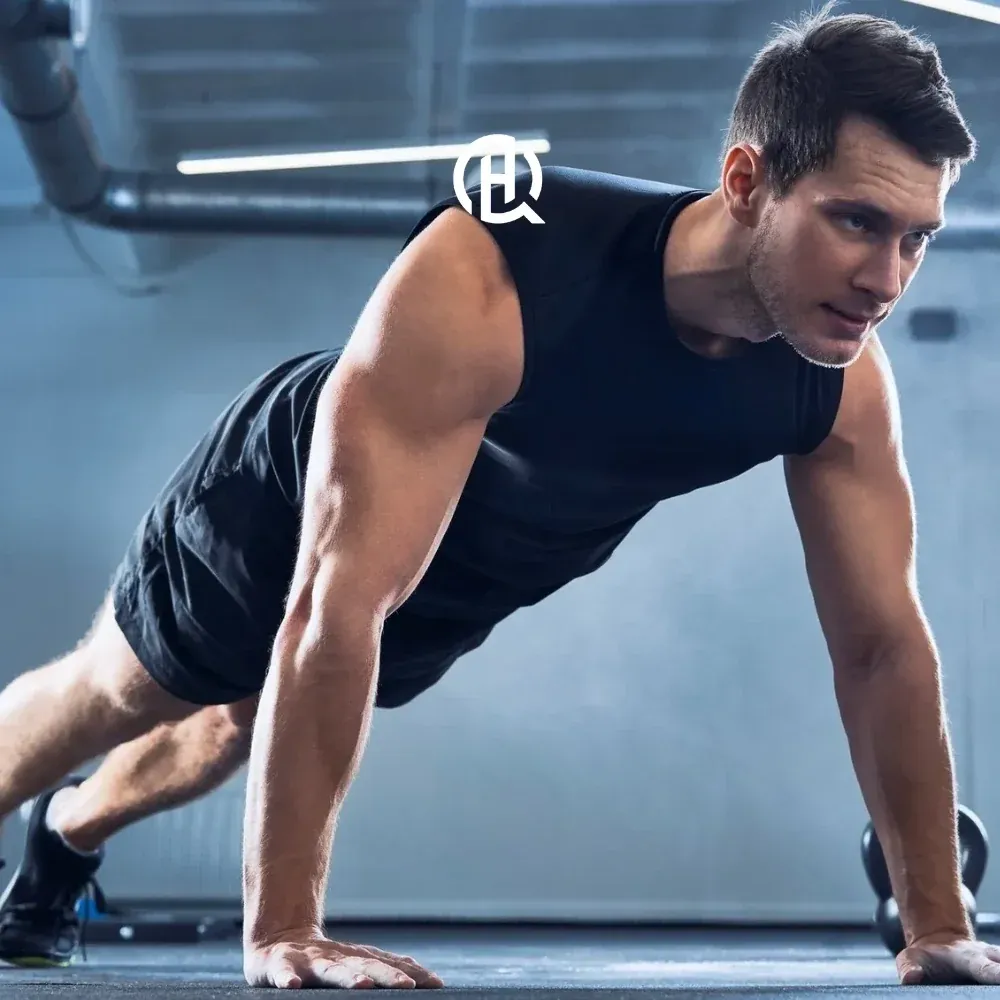
Push-ups train your chest, front shoulders and triceps, and your core and glutes work to keep your body in a straight line. The main benefits: you build upper-body pushing strength with no equipment, you can train anywhere, and you can make them easier or harder in small steps, from incline push-ups to one-arm push-ups.
Key takeaways
- Push-ups work the chest, front shoulders and triceps, with the core holding a plank the whole time.
- They need no equipment, so they are the easiest strength exercise to do consistently.
- Form beats volume: a straight body line and a full range of motion matter more than the rep count.
- Scale them to your level. Raise your hands to make them easier, raise your feet or add load to make them harder.
- Once you can do 3 sets of 15–20 clean reps, move to a harder variation.
- For fighters, push-ups train frame strength and a braced trunk. Count the ones you already do in class.
- Muscles
- Chest, front shoulders, triceps; core and glutes stabilise
- Equipment
- None (a bench or step for incline)
- Difficulty
- Beginner to advanced, depending on variation
- Sets & reps
- 3–4 sets of 8–20, or a harder variation once 20 is easy
Why do them
What are the benefits of push-ups?
Push-ups are on our list of the best chest exercises because anyone can start today.
- 01
Upper-body pushing strength
Every rep trains your chest, front shoulders and triceps together.
- 02
Core strength built in
The push-up is a moving plank. Your abs and glutes work to stop your hips sagging.
- 03
No equipment, no gym
You can train at home, in a hotel room or on a beach. That makes them easy to do consistently.
- 04
Easy to scale
Hands on a bench for beginners, feet on a bench or a weighted vest for advanced lifters. The same movement grows with you.
- 05
Free shoulder-blade movement
Unlike a bench press, your shoulder blades are not pinned to a bench, so they can move around your ribcage as you press.
- 06
Easy to track
Your rep count, or the variation you can do, is a clear measure of progress.
Anatomy
What muscles do push-ups work?
| Muscle | Role in the push-up |
|---|---|
| Chest (pectoralis major) | Main mover. Pushes your body away from the floor. |
| Front shoulders (anterior deltoids) | Help the chest press, more so with hands closer to your face or feet raised. |
| Triceps | Straighten the elbows. Work harder with a narrow hand position. |
| Core (abs, obliques) | Stop your hips sagging or piking. |
| Glutes and quads | Keep the legs and hips locked in line. |
Push-ups are not only a chest exercise. They are a full-body hold with a chest press built in.
Step by step
How to do a push-up
- 01
Set your hands
Place them slightly wider than shoulder-width, under or just outside your shoulders, fingers spread and pointing forward.
- 02
Make a straight line
Step your feet back. Squeeze your glutes and brace your abs so your head, hips and heels form one line.
- 03
Lower
Bend your elbows to about 45° from your body, not straight out to the sides. Lower until your chest is a fist's height from the floor or touches it lightly.
- 04
Press
Push the floor away until your arms are straight. Keep the body line; your hips and chest rise together.
- 05
Breathe
In on the way down, out on the way up.
What to avoid
Common push-up mistakes
Push-ups only look easy. Keep your back from arching and every rep honest.
Do
- Keep your head, hips and heels in one line.
- Lower until your chest is a fist's height from the floor or touches it lightly.
- Push the floor away until your arms are straight.
- Count only reps with a straight body and a full range of motion.
Avoid
- Sagging hips or arched lower back. Your core has switched off. Squeeze your glutes and shorten the set.
- Hips piked up. It turns the push-up into a shoulder press. Lower your hips into a straight line.
- Elbows flared to 90°. Hard on the shoulders. Tuck them to about 45°.
- Half reps. Stopping halfway down skips the hardest, most useful part of the rep. Go lower, or use an easier variation that lets you.
- Head dropping first. Your chin reaches the floor before your chest. Look at the floor slightly ahead of your hands.
- Racing through reps. Fast, sloppy reps are the rookie mistake. Take about 2 seconds down, 1 second up.
"When someone tells me push-ups are easy, I ask for ten with a two-second lowering and the chest touching the floor. Most people find out quickly that the rep count was hiding the form."
Herman Leir, Personal Trainer
Progress
Push-up variations from easy to hard
If push-ups bother your wrists, the chest press machine trains the same muscles.
- 01
Wall push-up
Hands on a wall. For absolute beginners.
- 02
Incline push-up
Hands on a bench or step. The higher the hands, the easier.
- 03
Knee push-up
Knees on the floor, body still straight from knees to head.
- 04
Standard push-up
Hands just outside shoulder-width, body straight from head to heels. The benchmark.
- 05
Close-grip (diamond) push-up
Hands close together. More triceps.
- 06
Decline push-up
Feet on a bench. More load on the upper chest and shoulders.
- 07
Weighted push-up
Weighted vest or a plate on your upper back (with a partner).
- 08
Archer push-up
One arm does most of the work, the other stays straight to the side.
- 09
Clapping push-up
Explosive, for power. Only once standard reps are solid.
- 10
One-arm push-up
Feet wide, full body tension.
Move up a step when you can do 3 sets of 15–20 clean reps.
Programming
Sets & reps by level
| Level | What to do | Sets & reps |
|---|---|---|
| Beginner | Incline or knee push-ups | 3 sets of 8–12 |
| Intermediate | Standard push-ups | 3–4 sets of 10–20 |
| Advanced | Decline, weighted or archer push-ups | 3–4 sets of 6–12 |
General guidance.
Frequency
Can you do push-ups every day?
You can do some push-ups most days if the sets are easy and your joints feel fine, for example a few sets well short of failure. Hard sets to failure need recovery. If you push to failure, give your chest, shoulders and triceps a day or two before the next hard session. If your shoulders or elbows start to ache, cut back. For more on how often to train, see how much you should train.
Fight sports
Push-ups for fighters
If you train Muay Thai, MMA or boxing, push-ups are a useful tool, and many fight gyms already use them in conditioning rounds. They build the pushing strength you use to hold a frame and push off in the clinch, and the plank position trains your trunk to stay braced. You need no equipment, so they fit at the end of a class or in a short circuit at home.
Two points to keep it honest. First, push-ups won't make you punch much harder on their own; punch power comes mostly from your legs, hips and trunk. Second, count the push-ups you already do in class.
For the wider plan, see strength and conditioning.
When
If your coach runs hard push-up rounds, don't add sets to failure the day before sparring.
How much
Keep extra sets 1–3 reps short of failure, and cut them in the last weeks before a fight.
Fast pushing
Swap in clapping push-ups. Do 3–5 crisp reps per set while you are fresh, not at the end of a hard session.
Who it's for
Who should do push-ups, and who should adjust
Good for: beginners, home trainers, travellers, and lifters who want extra chest volume without a bench.
Adjust: if your wrists hurt, use push-up handles or fists, or an incline. If you feel sharp pain in the shoulder, stop, shorten the range and tuck your elbows more. If it persists, get it checked.
Exercise library
Related exercises
Questions
Push-up FAQ
What do push-ups do for your body?
Push-ups build strength and muscle in your chest, front shoulders and triceps. At the same time, your abs, obliques and glutes work to hold your body in a straight line, so you also train core stability. Because they need no equipment and scale from wall push-ups to one-arm push-ups, they are one of the easiest strength exercises to keep doing for years.
Is it OK to do push-ups every day?
Easy daily sets are fine for most people if your shoulders, elbows and wrists feel good. The problem is hard sets to failure every day, because the muscles need time to recover. If you want to do push-ups daily, keep most sets a few reps short of failure, and take a day or two off from hard sets after a tough session.
How many push-ups should I do a day?
There is no magic number. A good starting point is 3 sets at a level where you can do 8–20 clean reps. Count only reps with a straight body and a full range of motion. When 3 sets of 15–20 feel easy, switch to a harder variation, such as decline or weighted push-ups, instead of just adding more reps.
Can push-ups build muscle?
Yes, as long as the sets are hard enough. Push-ups load your chest, shoulders and triceps the same way a press does, so taking sets close to failure builds muscle. The catch is that bodyweight gets easy over time. Keep progressing with harder variations, a weighted vest, or a slower lowering so the challenge keeps up with your strength.
Are push-ups better than the bench press?
Neither is better for everyone. Push-ups need no equipment, train your core and let your shoulder blades move freely. The bench press is easier to load heavy and to progress in small steps. For most people, the best plan is to use both: bench or dumbbell presses for heavy work and push-ups for extra volume, home sessions and travel.
Are push-ups good for fighters?
Yes. Push-ups build pushing strength for framing and the clinch, train your trunk to stay braced, and need no equipment, so they slot into class conditioning or a short home circuit. They are not a shortcut to punch power, which comes mostly from your legs and hips. Count the push-ups you do in class, and keep hard sets away from sparring days.
HermQ programs
Train with a plan.
One subscription unlocks every HermQ bodybuilding program while it is active. Billed monthly.
60-day money-back guarantee.
Use push-ups in your fight training? Combat Performance is HermQ's one-time program for combat strength and conditioning. The complete combat S&C system. Explosive power, fight conditioning, movement quality, and resilience for Muay Thai, MMA, and striking.
Get Instant Access – $29