Chest exercise guide
Bench Press Benefits
What the barbell bench press builds, and how to do it right
The bench press is the most loadable upper-body press in the gym. Here is what it does for your chest, shoulders and triceps, and how to get the setup right.

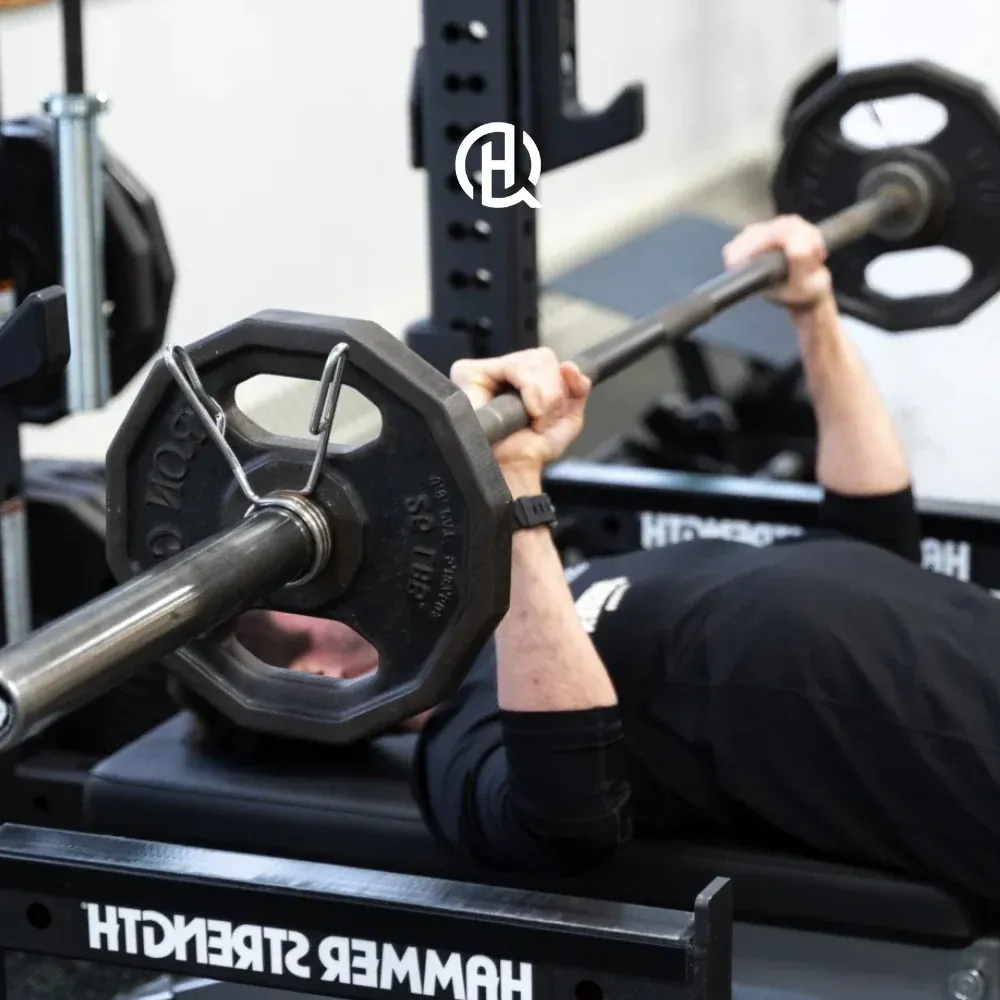
The bench press builds upper-body pushing strength and chest size. It works the chest, the front of the shoulders and the triceps in one lift, and it lets you use more weight than any other chest exercise. That makes progress easy to measure. Done with a stable setup and controlled reps, it suits almost every lifter.
Key takeaways
- Main muscles: chest (pectoralis major), front delts and triceps. Upper back, core and legs stabilise.
- It is the most loadable chest press, so it is the simplest way to get stronger and bigger over time.
- Setup decides everything: shoulder blades back, feet planted, grip a little wider than shoulders.
- Lower the bar to mid-chest with control, touch lightly, press. No bouncing.
- Use a spotter or safety arms when you go heavy.
- For fighters it builds pushing strength for frames and the clinch, not punch power. A few sets on an easier day is enough.
- Muscles
- Chest, front delts, triceps (stabilisers: upper back, core, legs)
- Equipment
- Barbell, flat bench, rack; spotter or safety arms for heavy sets
- Difficulty
- Beginner to advanced
- Sets & reps
- Strength 3–5 × 4–6 · Size 3–4 × 6–12
Anatomy
What muscles does the bench press work?
The bench press is a compound push. Three muscles do most of the work.
Chest (pectoralis major)
The prime mover. It brings your upper arms across your body as you press.
Front delts (anterior deltoids)
They help lift the arms forward and take more of the load as the bench gets steeper.
Triceps
They straighten the elbows and finish the lockout. A narrower grip uses them more.
Your upper back holds your shoulder blades in place, your core keeps your torso still, and your legs push you into the bench. That is why a good bench feels like a full-body lift.
Why do it
7 benefits of the bench press
- 01
Builds upper-body pushing strength
You can load a barbell heavier than dumbbells or a machine, and strength comes from handling heavy loads.
- 02
Builds chest size
Hard sets in a moderate rep range, progressed over weeks, are what grows the chest. The bench press lets you do that with small, steady jumps.
- 03
Trains three muscles at once
Chest, front delts and triceps work in the same rep, so one exercise covers most of your pressing muscles.
- 04
Progress is easy to measure
Weight and reps on a barbell are exact. You can estimate your max from any hard set with the one-rep max calculator.
- 05
Teaches full-body tension
Leg drive, a tight upper back and a braced core are skills that carry over to every heavy lift.
- 06
Carries over to other pushing
A stronger bench usually means stronger push-ups and dips, because they use the same muscles.
- 07
Has a variation for most goals
Incline for the upper chest, close-grip for triceps, dumbbells for range of motion, decline for the lower chest.
"The bench press is the first chest lift I teach. Not because it is the only option, but because it is the easiest to progress."
Herman Leir, Personal Trainer
Step by step
How to bench press
Set up
- 01
Eyes under the bar
Lie on the bench with your eyes under the bar. Head, upper back and glutes stay on the bench for the whole set.
- 02
Plant your feet
Plant your feet flat on the floor. If your feet do not reach, put plates or a box under them.
- 03
Take your grip
Grip the bar a little wider than shoulder width, wrists stacked over the elbows and as straight as possible.
- 04
Set your shoulder blades
Pull your shoulder blades back and down. Keep them there. This gives you a stable base and protects your shoulders.
Lift
- 05
Unrack
Unrack the bar with straight arms and bring it over your shoulders.
- 06
Brace and lower
Breathe in, brace your core, and lower the bar under control to mid-chest, elbows about 45° from your torso.
- 07
Touch lightly
Touch your chest lightly. Do not bounce.
- 08
Press
Press back up while pushing your feet into the floor. Breathe out near the top. Locking out the elbows at the top is fine.
- 09
Rack the bar
After the last rep, press to lockout and guide the bar back into the rack.
Get it right
Form cues that matter most
- 01
"Bend the bar."
Twisting your hands outward keeps elbows tucked and the upper back tight.
- 02
"Chest up to the bar."
A slight natural arch is fine. Lifting your hips off the bench is not.
- 03
"Push the floor away."
Leg drive starts every rep.
- 04
Same bar path every rep
Down to mid-chest, up and slightly back over the shoulders.
What to avoid
Common bench press mistakes
- 01
Bouncing the bar off the chest
It takes the chest out of the hardest part of the rep and is hard on the ribs.
- 02
Flaring the elbows to 90°
This loads the front of the shoulder. Keep them about 45°.
- 03
Hips leaving the bench
It shortens the range and strains the lower back.
- 04
Loose shoulder blades
If they slide forward, your shoulders take the load and the bar drifts.
- 05
Too much weight too soon
Add weight only when every rep looks the same.
- 06
Training heavy alone
Use a spotter or set the safety arms just below chest height. Stop if you feel sharp pain.
Options
Bench press variations
Incline barbell bench press
More upper chest. See the incline barbell bench press guide.
Dumbbell bench press
More range, each arm works alone. See the dumbbell bench press guide.
Close-grip bench press
More triceps. See the close-grip bench press guide.
Barbell decline bench press
More lower chest. See the decline bench press guide.
For the full ranked list, see the best chest exercises.
Programming
Sets and reps by goal
General guidance, not a prescription.
| Goal | Sets × reps | Rest |
|---|---|---|
| Strength | 3–5 × 4–6 | 2–3 min |
| Muscle growth | 3–4 × 6–12 | 1.5–2 min |
| Learning the lift | 2–3 × 8–10, light | 1–1.5 min |
Warm up with 2–3 lighter sets, building toward your working weight. When you hit the top of the rep range on every set with clean form, add the smallest jump the gym allows.
Who it's for
Who should bench press, and who should skip it?
- Good for: anyone who wants a bigger, stronger chest, shoulders and triceps; lifters who like measurable progress; powerlifters, since it is a competition lift.
- Swap or adjust if: a flat barbell press hurts your shoulders. Try dumbbells, a slight incline, or the chest press machine first. If pain is sharp or does not go away, stop and get it checked.
- No barbell or rack? Push-ups train the same muscles. See push-up benefits.
For fighters
Bench press for fighters
If you train MMA, grappling or Muay Thai, the bench press is useful, but be clear about what it does. It will not do much for punch power. That comes mostly from your legs, hips and trunk. What it builds is pushing strength: holding a frame when someone is on top of you, pushing an opponent off in the clinch, and creating space to get back to your feet.
For how lifting fits around fight training, see strength and conditioning for fighters.
Program it around your skill training, not the other way round.
When
Bench on an easier day, or several hours away from hard sparring.
How much
Two or three working sets of 3–6 reps are enough, each stopped 1–3 reps short of failure. Cut the number of sets as a fight gets close.
Worn shoulders
If your shoulders feel worn from a lot of punching, swap the barbell for dumbbells or a close-grip floor press for a few weeks. The floor limits the range at the bottom.
Questions
Bench press benefits: FAQ
What muscles does the bench press work?
The bench press mainly works the chest (pectoralis major), the front delts and the triceps. The chest does most of the pressing, the front delts help lift the arms forward, and the triceps straighten the elbows at the top. Your upper back, core and legs work to keep you stable, which is why a heavy bench feels like a full-body effort.
Is the bench press good for building chest?
Yes. It is one of the best chest builders because you can load it heavy and add weight in small steps for a long time. For most people, 3–4 hard sets in the 6–12 rep range, once or twice a week, is a good start. Pair it with an incline press and a fly to cover the upper chest and the stretch.
Should the bar touch your chest on bench press?
For most lifters, yes. Lower the bar under control until it lightly touches your mid-chest, then press. That gives you the full range of motion. What you want to avoid is bouncing the bar off your chest to get it moving. If touching hurts your shoulders, stop just above the chest and work on your setup.
Is it safe to lock out your elbows on bench press?
Yes, for healthy lifters it is normal to straighten your arms fully at the top of each rep. Locking out lets the triceps finish the press and gives you a stable position to breathe and rack the bar. Lock out smoothly instead of snapping the elbows straight, and keep the bar over your shoulders.
Do you need a spotter to bench press?
For light sets you can bench without one if you stop well short of failure. For heavy sets or sets close to failure, use a spotter or a rack with safety arms set just below your chest. Never bench heavy alone with collars on and no safeties. If you get stuck, a spotter is the simplest fix.
How much should I bench press?
There is no single right number. It depends on your body weight, training age and goal. Track your own progress instead: log weight and reps every session, and estimate your max from a hard set with the one-rep max calculator. If the number goes up over months with the same clean form, you are on track.
Is the bench press good for fighters?
It is a useful lift, not a must. The bench press builds the pushing strength you use to hold frames, push off in the clinch and get back up in MMA or grappling. It adds little to punch power, which comes mostly from the legs, hips and trunk. Two or three sets on an easier training day, stopped short of failure, is enough.
HermQ programs
Put the bench press in a plan
Every HermQ bodybuilding program is in one $19/month subscription, from the 3-day split to Shredded & Muscular. Billed monthly while it is active.
Bench for a fight sport? Combat Performance is a one-time $29 purchase with lifetime dashboard access.
Get Instant Access – $29