Chest exercise guide
Chest Press Machine
How to set it up, press with good form and use it to build your chest
The chest press machine lets you push hard with a fixed, stable path. Set the seat right and it is one of the easiest ways to train your chest close to failure without a spotter.

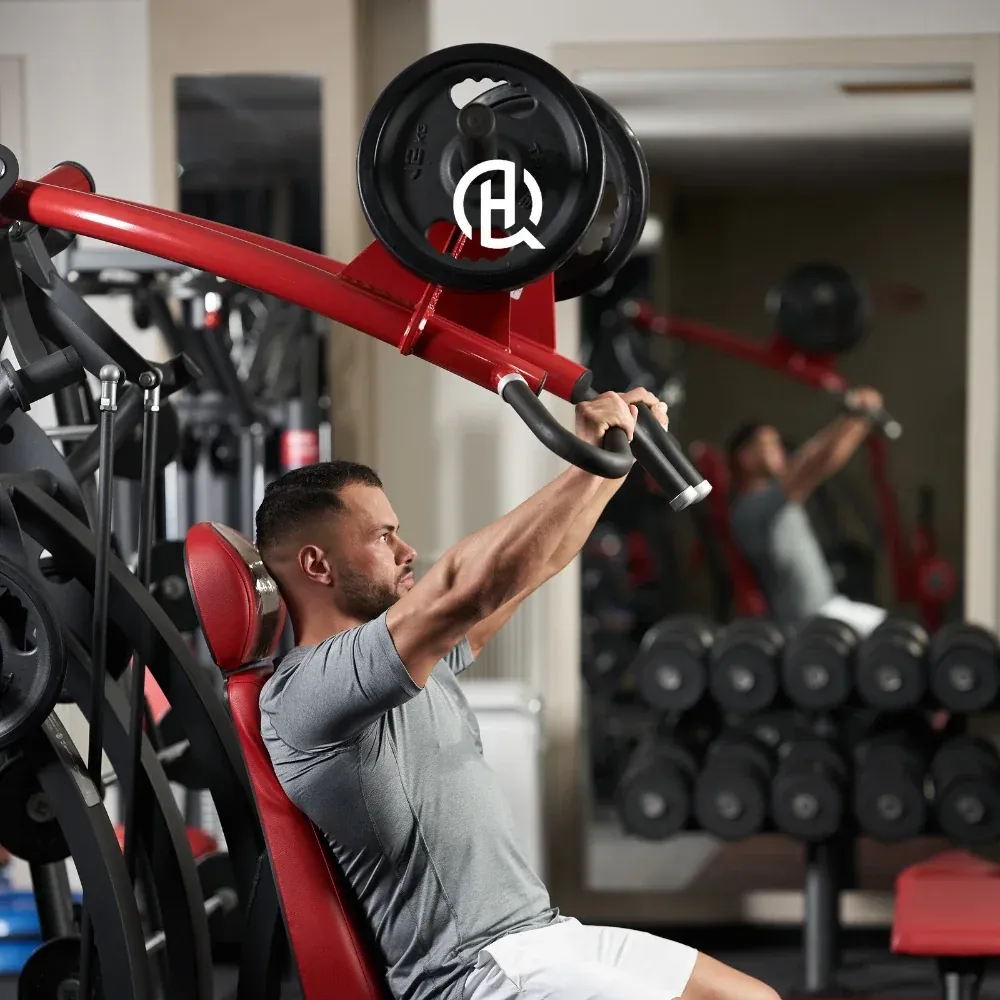
The chest press machine is a seated press that trains your chest, front shoulders and triceps on a fixed path. Set the seat so the handles line up with your mid-chest, keep your shoulder blades back against the pad, press until your arms are almost straight, and lower slowly until you feel a stretch across your chest.
Key takeaways
- Seat height decides the exercise: handles at mid-chest height, not at your neck or your belly.
- Keep your shoulder blades pinned to the pad for the whole set. That keeps the work on your chest.
- Lower slowly (about 2–3 seconds) and stop where you feel a stretch, not where your shoulders roll forward.
- It is stable and needs no spotter, so you can safely push sets close to failure.
- Use it alongside free-weight presses, not instead of them, if you want the full range of chest work.
- Muscles
- Chest (pecs); front shoulders and triceps assist
- Equipment
- Seated chest press machine
- Difficulty
- Beginner
- Sets & reps
- 3–4 × 8–12 for muscle growth
Step by step
How to use the chest press machine
- 01
Set the seat
Sit down and adjust the seat so the handles are level with the middle of your chest. If the handles sit at your collarbones, the seat is too low. If they sit near your belly, it is too high.
- 02
Set your feet and back
Feet flat on the floor, about hip-width. Back, hips and head against the pad.
- 03
Set your shoulders
Pull your shoulder blades back and down into the pad. Keep a slight natural arch in your lower back, not a big one.
- 04
Grip the handles
Use the horizontal grip for more chest, the vertical (neutral) grip if your shoulders prefer it. Wrists straight, knuckles pointing up or forward, not bent back.
- 05
Press
Breathe out and push the handles forward until your arms are almost straight. Do not slam into lockout.
- 06
Lower slowly
Breathe in and let the handles come back over 2–3 seconds, until you feel a stretch across your chest. Stop before your shoulders roll forward off the pad.
- 07
Repeat
Do your planned reps without letting the weight stack touch down between reps.
Get it right
Form cues
Do
- Elbows at about 45°. Not flared straight out to the sides, not pinned to your ribs.
- Chest up, shoulders down. Think "proud chest" before every rep.
- Push through the heel of your hand. It keeps the wrist straight and stops the handles drifting.
- Control the way back. The lowering is half the rep. If you can't control it, the weight is too heavy.
Common mistakes
- Seat too low or too high. The handles start at your neck or belly, and your shoulders or triceps take over. Fix: handles at mid-chest.
- Shoulders rolling forward. At the end of the press or at the bottom, the shoulder blades leave the pad. Fix: keep them pinned, and stop the rep where they would lift.
- Bouncing the weight stack. Letting the plates touch and rebound between reps takes tension off the chest. Fix: stop just short of the stack.
- Half reps with too much weight. Short, fast reps look strong and build little. Fix: drop the weight and use the full range you can control.
- Flared elbows and bent wrists. Both put strain on the shoulder and wrist. Fix: elbows about 45°, wrists stacked over the forearm.
"The fix I make most often when I coach this machine is the seat. Move it two notches and the same exercise suddenly hits the chest."
Herman Leir, Personal Trainer
Options
Variations
Neutral-grip chest press
Palms facing each other. Often more comfortable for the shoulders, slightly more triceps.
Single-arm chest press
One handle at a time. Good for evening out a weaker side. Brace your core so your torso doesn't twist.
Incline chest press machine
If your gym has one, the upward angle puts more work on the upper chest.
Plate-loaded chest press
The same pattern with plates instead of a stack. Usually a smoother strength curve and easier small jumps in load.
Programming
Sets & reps by goal
General guidance, not a program.
| Goal | Sets | Reps | Rest |
|---|---|---|---|
| Learning the movement | 2–3 | 12–15 | 60–90 s |
| Muscle growth | 3–4 | 8–12, last 1–2 reps hard | 90 s–2 min |
| Strength | 3–5 | 5–8 | 2–3 min |
| Finisher after free weights | 1–2 | 15–20 | 60 s |
Place it after your main free-weight press, or use it as your main press on days your shoulders or lower back need a break from the bench.
Why do it
Benefits of the chest press machine
- 01
Stable and easy to learn
The machine sets the path, so beginners can focus on pushing, not balancing.
- 02
No spotter needed
If you fail a rep, you let the handles come back. That makes hard sets safer when you train alone.
- 03
Easy to load in small steps
Moving the pin one plate is quicker and more precise than changing dumbbells.
- 04
Chest focus with less stabilising work
Because the machine stabilises for you, more of your effort goes into the press itself.
- 05
Shoulder-friendly options
A neutral grip and a controlled range make it a good choice on days the bench press feels uncomfortable.
Fit
Who it's for and who should skip it
Good for: beginners learning to press, lifters training alone, anyone adding chest volume after free weights, and people working around a lower-back or balance limit.
Skip it or adjust: if pressing gives you sharp shoulder pain, stop. Try a neutral grip and a shorter range. If the pain stays, get it checked before you keep pressing.
Compared
Chest press machine vs other chest exercises
| Exercise | Compared with the chest press machine |
|---|---|
| Barbell bench press | Free weight, so you also train balance and stability. Lets you load heavier over time but needs a spotter or safety pins. |
| Dumbbell bench press | Each arm works on its own and you get a bigger range of motion. Harder to set up when the weights get heavy. |
| Push-ups | No equipment, and your core works to hold the plank. Harder to load in small steps. |
| Pec deck | Isolates the chest with no triceps help. Use it after a press, not instead of one. |
For the full ranking of chest moves, see the full list of the best chest exercises.
Questions
Chest press machine FAQ
What muscles does the chest press machine work?
The chest press machine mainly works your chest, the pectoralis major. Your front shoulders and your triceps help with every rep, because they assist in any pressing movement. A horizontal grip with elbows at about 45 degrees keeps most of the work on the chest. A neutral grip shifts a little more work to the triceps and is often easier on the shoulders.
Is the chest press machine as good as the bench press?
They do different jobs. The bench press trains balance and stability and lets you load heavy over time, but it needs a spotter or safety pins. The chest press machine is easier to learn and safer to push close to failure on your own. Most people do best with both: a free-weight press first, then the machine for extra chest work.
How do I set the seat height on a chest press machine?
Sit with your back against the pad and look at where the handles meet your body. They should line up with the middle of your chest, roughly level with your nipples. If they sit at your collarbones, raise the seat. If they sit near your belly, lower it. Your feet should rest flat on the floor while your back stays on the pad.
How many sets and reps should I do on the chest press machine?
For muscle growth, 3–4 sets of 8–12 reps works well, with the last one or two reps feeling hard. For strength, use 3–5 sets of 5–8 with longer rest. Beginners can start with 2–3 sets of 12–15 to learn the movement. When you hit the top of your range on every set with clean reps, add weight.
Is the chest press machine good for beginners?
Yes. The machine guides the path of the handles, so you can learn to press without balancing a bar or dumbbells. It is also safe to train alone, because a failed rep just means letting the handles return. Start light, learn the seat setup and the slow lowering, and then add weight in small steps as your form stays consistent.
HermQ programs
Train your chest with a plan.
One $19/month subscription unlocks every HermQ bodybuilding program while it is active. Billed monthly.
60-day money-back guarantee.