Training guide
BJJ Belt System
The order, the kids ranks, and what coral and red actually mean.
The BJJ belt system, from a Muay Thai coach: adult and kids belt order, stripes, how long each rank takes, and what a coral belt and a red belt are.

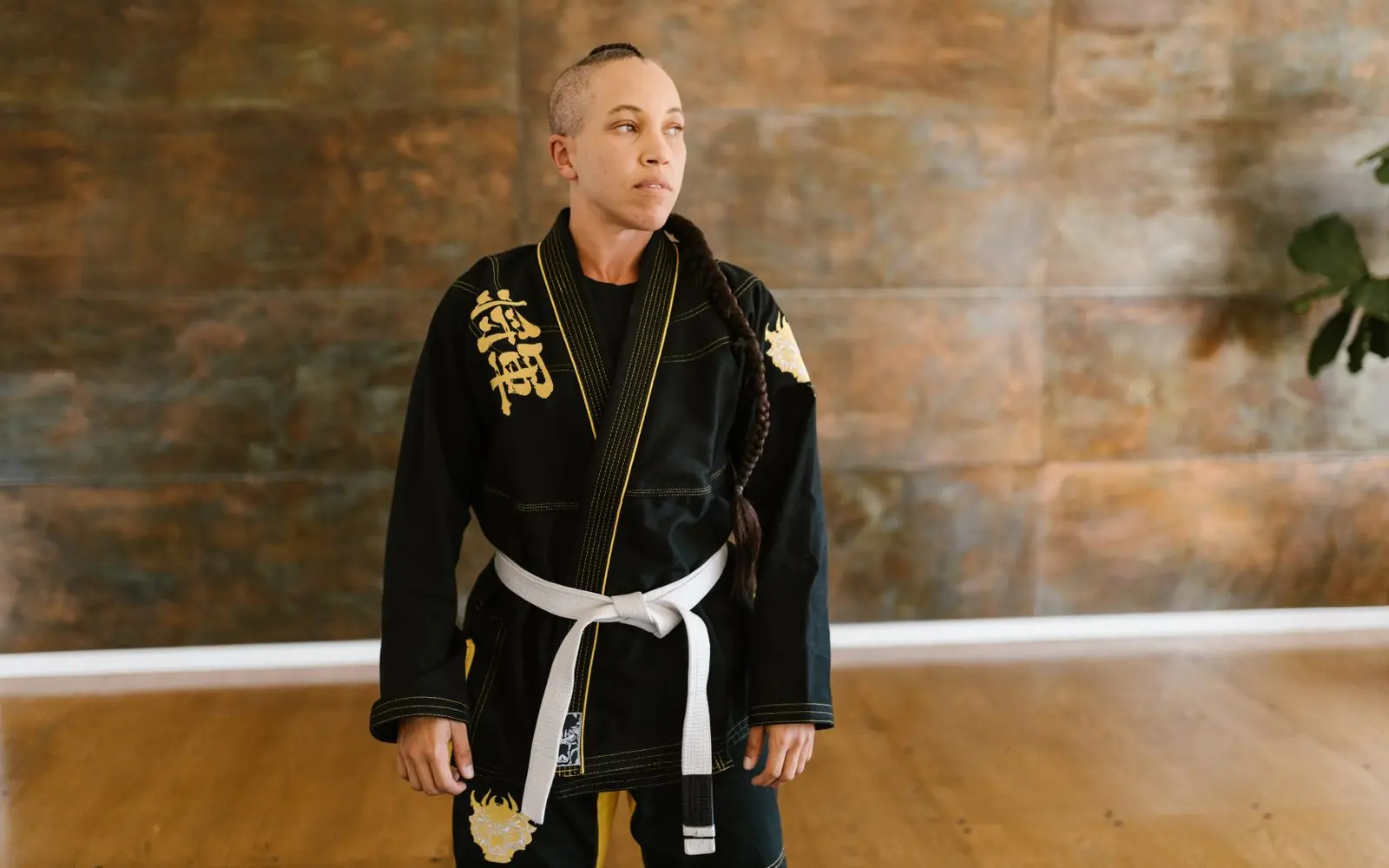
The BJJ belt system is a record of time and of what a professor has seen. Adults go white, blue, purple, brown, black, then the master belts. Kids use a different order, and it ends at 15.
I coach Muay Thai and kickboxing. I do not promote jiu-jitsu belts, and I do not hold one. The mat is not the room I teach. What I do need, every time a striker asks what the colors mean, is the map. This page is that map, taken from the IBJJF General System of Graduation, plus the plain reading of what each color usually means in a class.
The belt your professor ties is their decision. IBJJF recognizes a rank for its events and certificates when the age and the time match the system below. A gym can keep you longer than the minimum. It cannot make IBJJF accept a rank that arrived early.
Key takeaways
- The adult BJJ belt order is white, blue, purple, brown, black, red and black, red and white, then red.
- Standard adult time, with no kids rank and no world title behind you, is 2 years at blue, 1 year and 6 months at purple, and 1 year at brown. White has no minimum time.
- A black belt is generally 19 or older. IBJJF allows 18 only for an athlete who won the Adult World Championship at brown belt.
- The kids belt order runs from white through the grey, yellow, orange and green groups. There is no minimum time in any kids belt, and those colors stop at 15.
- A coral belt is the gym name for red and black (7th degree) and red and white (8th degree). A red belt is the 9th degree, and the 10th degree was given only to five pioneers.
Adults, 16 and up
BJJ Belt Order
Eight belts. The first five are the ones you will see in almost every class. The last three are decades away.
- White
- Blue
- Purple
- Brown
- Black
- 7th, red and black
- 8th, red and white
- Red
For athletes 16 and older, the BJJ belt ranks in order are white, blue, purple, brown, black, red and black, red and white, and red. That is Article 1 of the IBJJF system. White through black is the path a normal training life is about. Red and black is the 7th degree. Red and white is the 8th. Red is the 9th and 10th.
Blue starts at 16. Purple starts at 16. Brown starts at 18. Black starts at 19, with one exception I will put in the time section: an Adult World Champion at brown belt may be promoted at 18. If you are comparing this with the arts around a fight, the styles themselves are the grappling guide. This page is only the colors.
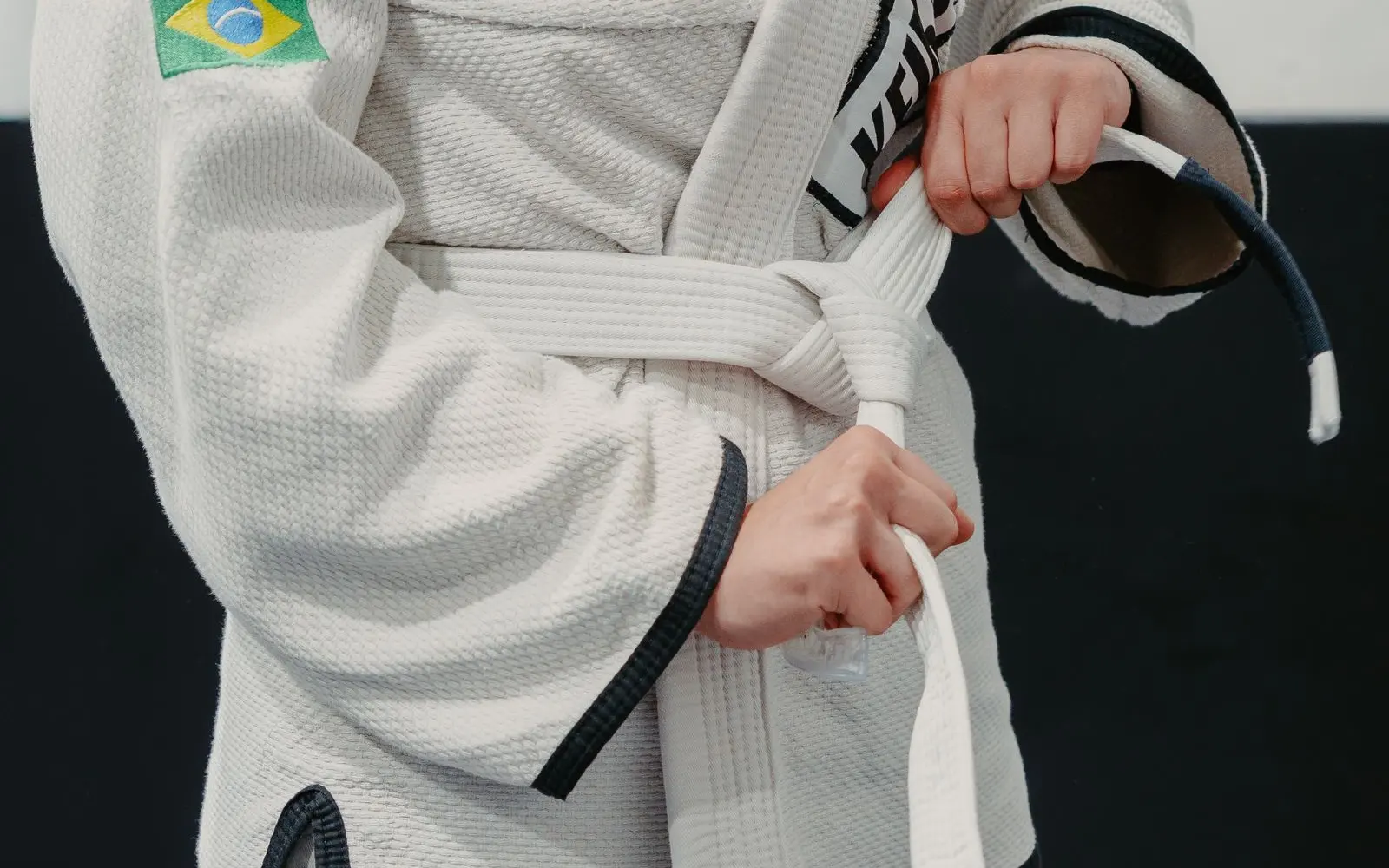
IBJJF counts age as the current year minus the birth year. The age applies for the whole calendar year, including the months before the birthday. Someone born in 2010 counts as 16 for every month of 2026.
In the class
What the BJJ Belt Ranks Mean
IBJJF does not publish a move list for each color. This is what the belts usually mean on the mat, the way I read a student's striking by what still holds when they are tired.
- 01
White
You are learning where your hips and hands go, how to fall, and how to tap. A useful white belt can keep posture in one bad spot they have drilled. They still get lost once the other person moves. There is no game yet, and there should not be.
- 02
Blue
You can hold one or two positions against people newer than you, and you have a small set of attacks that work when the position is already there. Against a purple belt the details fall apart. This is where a lot of people either quit or start to understand the sport.
- 03
Purple
A game shows up. Guard, passing and escapes start to connect, instead of living as separate drills. It often feels like the long belt, even though the standard minimum here is shorter than the minimum at blue. The jump is the skill, not the clock.
- 04
Brown
The game is tighter. Attacks chain, the first idea can fail without the round ending, and there are fewer empty moves. You can often see the mistake, not only feel it. That is why brown belts start to be useful as training partners who can explain the rep.
- 05
Black
You can do the thing and explain it. In the IBJJF system a black belt is also who signs the ranks below. Six degrees sit on the black belt before the color changes, and those degrees are years of activity. They are not six new techniques.
- 06
Past black
Red and black, red and white, and red are not a new syllabus. They are time, teaching, and a record IBJJF will certify. If a gym treats them as the next belt after brown, that gym is not using this system.
Read those as a coach's translation, not as an exam. Two blue belts from two gyms can look different, because the professor decides when the color changes, inside the minimums. What should be true of both is that the higher belt can keep a position the lower belt is still visiting.
The same idea is how I coach striking. I do not hand out a color. I look at whether the stance holds, whether the balance stays under you, and whether the timing is still there when you are breathing hard. A jiu-jitsu professor is watching a different skill with the same kind of eye. The position either stays, or it does not.
The clock
Age and Time in Grade
Minimums, not promises. A professor can wait. IBJJF will not recognize a promotion that beats the clock, except on the paths in the note.
| Belt | Minimum age | Standard time in the belt |
|---|---|---|
| White | Any age | No minimum. The clock for blue does not start until the belt is blue |
| Blue | 16 | 2 years before purple, from age 18. No minimum at 16 or 17 |
| Purple | 16 | 1 year and 6 months before brown. A 16 or 17 year old is not eligible for brown yet |
| Brown | 18 | 1 year before black |
| Black | 19, or 18 for one case | The next color is a degree system, not a fifth year. See the coral section |
Ages and times are the IBJJF General System of Graduation. The 18-year-old black belt is only for an athlete who has won the Adult World Championship at brown belt. Everyone else waits until 19.
Add the standard adult path and you get four and a half years from blue to black: 2 years, then 1 year and 6 months, then 1 year. That sum leaves out the time a professor keeps you at white, and it leaves out every shorter path below. It is the plain reading of the minimums, not a date anyone owes you.
IBJJF shortens some of those stays when the earlier record is already registered with them. At blue, the 2 years become 1 year if you were registered before as grey, yellow or orange. There is no minimum at blue if you were registered as green, as a juvenile blue belt, or you are the adult blue-belt world champion. At purple, the stay becomes 1 year if you were a juvenile blue belt. There is no minimum at purple if you were registered as orange or green and also as a juvenile blue, or you were a juvenile purple, or you are the adult purple-belt world champion. At brown, there is no minimum if you are the adult brown-belt world champion.
At 16 and 17, white and blue have no minimum time. Purple at those ages still cannot move to brown. Brown belongs to the adult division. The periods count from the day the belt is registered with IBJJF, not from the day a gym posted a photo.
Up to brown belt, using stripes is the professor's choice. From black belt up, the times are fixed. You request the next degree after the period. You do not receive it early. The years count only when IBJJF can see activity that year, such as an active membership, time registered as a professor, or a title at an IBJJF event. A quiet year does not count.
The tape
Stripes on a BJJ Belt
Four degrees on white, blue, purple and brown. Six degrees on black. The tape is a mark inside the belt, not a belt of its own.
IBJJF calls them degrees. In a gym you will hear stripes. On white, blue, purple and brown, the belt is divided into four degrees. They are usually a piece of tape on the black bar at the end of the belt. The professor decides whether to use them at all. IBJJF does not require the four degrees before it will recognize the next color, as long as the age and the time are met.
A black belt is different. It carries up to six degrees, marked on a red bar between two white bars. IBJJF only recognizes black-belt degrees that follow its timeline. A stripe a gym added on its own, ahead of that timeline, is not a degree IBJJF will certify.
What actually earns one
There is no published list of techniques that equals one stripe. The honest version is boring. You show up, one position gets cleaner, and the professor has seen it enough times to mark the belt. Asking for the tape is a worse plan than asking what they want to see this month. I would rather a student leave class knowing the one detail to repeat than leave with a new piece of tape they cannot explain.
Four stripes do not make a new belt. They mean you are still the color you were, with a note that the month was not empty. When the fourth stripe and the minimum time and the professor's eye all agree, the next color is a conversation. The stripe does not have that conversation by itself.
Ages 4 to 15
BJJ Kids Belt System
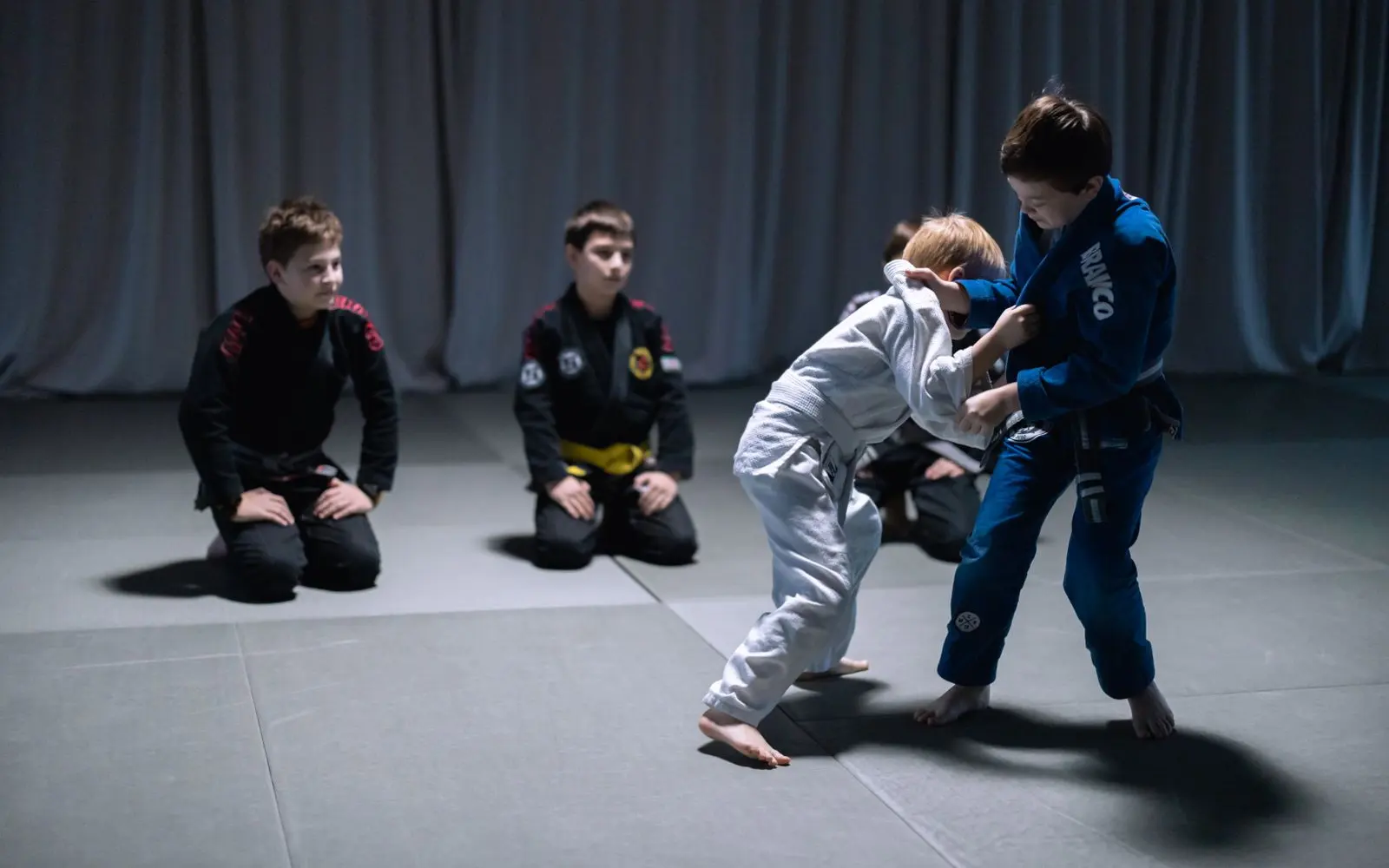
Thirteen belts, in four color groups, and no minimum time in any of them. They are not small versions of blue, purple and brown.
| Group | Belts, in order | Minimum age |
|---|---|---|
| White | White | Any age |
| Grey | Grey and white, then grey, then grey and black | 4 |
| Yellow | Yellow and white, then yellow, then yellow and black | 7 |
| Orange | Orange and white, then orange, then orange and black | 10 |
| Green | Green and white, then green, then green and black | 13 |
Grey, yellow, orange and green all stop at 15. There is no minimum time in any belt from 4 to 15.
The full kids order, from the start, is white, grey and white, grey, grey and black, yellow and white, yellow, yellow and black, orange and white, orange, orange and black, green and white, green, and green and black. A child does not have to wear every one. There is no minimum stay, so a professor can move a student when the age group allows it and the class is ready. The age floors still hold. Yellow is not for a 5 year old. Green is not for a 10 year old.
IBJJF suggests ways to divide a kids belt into degrees, including three degrees across a year for gyms that graduate every three months. None of those methods is required. Kids stripes are a gym choice. They are not the four adult stripes, and they are not a shortcut into blue.
What happens at 16
At 16 the athlete leaves the kids belts and uses the adult order. White may stay white. A grey, yellow or orange belt becomes blue. A green belt may become blue or purple, and the professor decides. The split belts, grey and white through green and black, sit inside those groups, and they do not continue once the athlete is 16.
That handoff is why a green belt on a 15 year old is not "almost a black belt." It is the top of the kids groups. Purple, if the professor chooses it at 16, is the first adult belt past blue, and brown is still waiting on 18.
After black
What Is a Coral Belt in BJJ?
Coral is the name gyms use. IBJJF writes two colors: red and black for the 7th degree, red and white for the 8th.
A coral belt is not a kids belt, and it is not the belt after brown. In most gyms the word covers both master belts. Red and black is the 7th degree black belt. Red and white is the 8th degree black belt. If someone says coral and means only one of them, ask which degree. The belts are worn in alternating bars, with degrees marked between silver bars on a white tab at the end.
The time is fixed. The 7th degree can be requested at 50 or older, after 7 years from the 6th degree, or with 31 years of proven black-belt activity under IBJJF. The 8th degree can be requested at 57 or older, after 7 years from the 7th, or with 38 years of that activity. These are not belts a hard year of training produces. They are a life in the art that IBJJF can document.
| Degree | Belt | From the mark before | Years at black |
|---|---|---|---|
| 1st | Black | 3 years at black | 3 |
| 2nd | Black | 3 years | 6 |
| 3rd | Black | 3 years | 9 |
| 4th | Black | 5 years | 14 |
| 5th | Black | 5 years | 19 |
| 6th | Black | 5 years | 24 |
| 7th | Red and black | 7 years, age 50 | 31 |
| 8th | Red and white | 7 years, age 57 | 38 |
| 9th | Red | 10 years, age 67 | 48 |
Either column can qualify a request: the time since the previous degree, or the total years of proven black-belt activity. From black belt up, the periods are fixed.
What is a red belt in BJJ?
A red belt is the grand master belt. IBJJF uses it for the 9th and 10th degrees. The 9th can be requested at 67 or older, after 10 years from the 8th degree, or with 48 years of proven black-belt activity. The bar at the end is marked between gold bars, not silver ones.
The 10th degree was given only to the pioneers of Brazilian jiu-jitsu: Carlos, Oswaldo, George, Gastão and Helio Gracie. It is not a rank you apply for. A red belt on a child in another martial art is a different system. In this one, red is the far end of a black belt's life, and a red stripe on a black belt is only a degree mark, not a red belt.
Other rooms
How the Belts Compare With Striking
Boxing has no belt. Muay Thai has no universal one. Jiu-jitsu wrote the years down. That is the whole difference.
In the room I coach, progress is a detail that stays when you are tired. A better stance. Better balance. Better timing. There is no color for that. Boxing does not have a belt system at all. You are new, you are an amateur, or you have fights. The round is the record. If you are setting the feet for the first time, that work is the boxing stance, and the first month of it is how to start boxing.
Muay Thai, in Thailand, does not grade you with a belt either. The prajiad is a colored armband of the camp, not a test you pass. Some gyms outside Thailand have built their own colors. Those colors stay in that gym. They do not travel the way an IBJJF belt is meant to travel. The skill I can actually coach is the kick and the clinch, which is Muay Thai kicks and what Muay Thai is, not a stripe on a waist.
Karate and taekwondo schools often move a belt in months. That can be a fair system for that school. It is a different clock. An adult blue belt in jiu-jitsu is measured in years, and the professor can still wait past the minimum. If a gym promises you a BJJ belt on a holiday timetable, they are not describing this system.

When the gi comes off, there is nothing to tie. You do not earn a separate no-gi belt. The rank is the one you already hold. MMA goes further: there is no belt in the cage. A better shot, a cleaner stand-up, and a position you can keep are the record. That week, striking and grappling together, is the MMA training guide. Shadow rounds will not teach the belt or the hold. They still belong in a striking week, and they live in the shadow boxing guide.
The month
How to Progress Without Chasing the Belt
One coached class. One position. The belt moves when the professor has seen the position hold, and when the clock allows it.
| Day | Session | What the month is for |
|---|---|---|
| Monday | Muay Thai | Technical class. Keep the striking you already have. No hard spar on the day before jiu-jitsu |
| Tuesday | Rest | Walk if you want. No rounds and no roll |
| Wednesday | Jiu-jitsu | One coached class. One position for the month. Tap early. You are a white belt until that professor says otherwise |
| Thursday | Strength | Squat, pull-up, farmer's carry. Short, with reps left. The lift is not the rank |
| Friday | Pads or bag | Striking only. If this day becomes a hard spar, Wednesday stays drill-only |
| Saturday | Optional | Easy shadow boxing, or skip it. Do not add a second roll |
| Sunday | Rest | Full rest. This is the day the week sticks |
A hard spar and a hard roll are two hard days. This month does not stack them.
Run that week for a month before you change it. The only progression that counts is a cleaner position: you keep the guard without straightening an arm for someone to take, or you recover posture without sticking your neck out. Do not add a submission because the month felt quiet. The strength and conditioning guide is where the Thursday lift belongs. It supports the class. It does not replace it.
- 01
Pick one professor.
Belts are their record of you. A new gym every month restarts the watching, even when the IBJJF clock does not.
- 02
Stay on one position.
Ask what they want held this month. A stripe, if the gym uses them, comes after that, not before.
- 03
Keep the striking days.
If you came in as a striker, do not quit the jab to chase a belt. One grappling day is the add.
- 04
Let the clock be the clock.
White has no minimum. Blue, purple and brown do, unless you are on one of the registered shorter paths. Nobody skips them by asking.
Combat sports
Belts and a Fight Camp
Once a fight is booked, the belt is not the camp. You do not take a promotion, or a new submission, in fight week.
The rank you walk in with is the rank you keep until the camp is over. Skill rounds stay specific: the position you lose, the shot you miss, the kick you cannot bring home. The MMA training guide is how that week is built when striking and grappling are both the sport. The lift stays short, around the skill, which is what Combat Performance is for.
- One problem per session. The position you lose, or the strike that sets it up. Not a new belt.
- Skill work comes first. Pads, wrestling and jiu-jitsu decide the day. The lift fits around them.
- Do not test for a stripe in camp. The professor can wait. The bout will not.
- Keep a round in the tank on fight week. Same positions, half the time.
- The belt is not the game plan. Your opponent does not lose because of the color in your bag.
- Position first
- Then the belt
Flagship program · Combat Performance
Strength and conditioning for the weeks around your striking and your grappling. Power, a grip that lasts, and legs that still have a step in the last round.
What to avoid
Common Belt Mistakes
Five ways people misread a color, including a few I have had to unwind for strikers who just walked into a gi.
- 01
Treating kids colors as adult belts
Yellow, orange and green are kids groups with age floors. They are not the belts a 30 year old wears on the way to blue.
- 02
Calling a stripe a promotion
Four degrees can sit on white, blue, purple and brown. You are still that belt. The next color is a separate decision.
- 03
Expecting a belt on a timetable
The minimums are floors. A professor can keep you at blue past two years. A gym that promises the next color by a date is selling a different product.
- 04
Using "coral" for a red belt
Coral, in gym speech, is red and black or red and white. Red is the 9th and 10th degrees. They are not the same belt with a nickname.
- 05
Importing a striking grade
Years of pads do not convert. You start at white, in a class, with a professor of that art. I will not pretend a clinch lesson is a belt.
Questions
Common Questions About the BJJ Belt System
What is the BJJ belt system?
The BJJ belt system is the rank order Brazilian jiu-jitsu uses to record time and a professor's judgment. For adults 16 and older, IBJJF's order is white, blue, purple, brown, black, red and black, red and white, and red. Kids from 4 to 15 use a separate order of white, grey, yellow, orange and green, including the split belts in each group. The professor ties the belt. IBJJF recognizes it when the age and the time match its General System of Graduation.
What is the BJJ belt order?
The adult order is white, blue, purple, brown, black, red and black (7th degree), red and white (8th degree), and red (9th and 10th degree). The kids order is white, grey and white, grey, grey and black, yellow and white, yellow, yellow and black, orange and white, orange, orange and black, green and white, green, and green and black. At 16, white may stay white, grey, yellow and orange become blue, and green may become blue or purple.
What are the BJJ belt ranks for adults?
White has no minimum time. Blue is 16 or older and the standard stay is 2 years. Purple is 16 or older and the standard stay is 1 year and 6 months, but a 16 or 17 year old cannot move to brown yet. Brown is 18 or older, with a standard stay of 1 year. Black is 19 or older, or 18 only if the athlete won the Adult World Championship at brown belt. Registered kids ranks and adult world titles can shorten the stays at blue, purple and brown.
What is a coral belt in BJJ?
A coral belt is the gym name for the two master belts after black. IBJJF lists them by color. Red and black is the 7th degree, requested at 50 or older after 7 years from the 6th degree or 31 years of proven black-belt activity. Red and white is the 8th degree, requested at 57 or older after 7 years from the 7th or 38 years of that activity. From black belt up, those periods are fixed.
What is a red belt in BJJ?
A red belt is the grand master belt, used for the 9th and 10th degrees. The 9th degree can be requested at 67 or older, after 10 years from the 8th degree or 48 years of proven black-belt activity. The 10th degree was given only to the pioneers Carlos, Oswaldo, George, Gastão and Helio Gracie. It is not a belt a local gym awards, and it is not a kids color in this system.
How does the BJJ kids belt system work?
From ages 4 to 15 there is no minimum time in any belt. White is any age. The grey group starts at 4, yellow at 7, orange at 10, and green at 13. Each of those groups has a white-split belt, a solid belt, and a black-split belt, in that order. Stripes on kids belts are optional. At 16 the kids colors stop and the adult order begins.
Do stripes count as a new belt?
No. On white, blue, purple and brown, IBJJF describes four degrees, which gyms call stripes. Using them is the professor's choice, and you remain that belt. A black belt has six degrees on its own timeline, and IBJJF only recognizes degrees that match it. A stripe is a mark inside the rank, not the next rank.
Final thoughts
Learn the position. Let the belt be the record.
The BJJ belt system is simple once you separate the clock from the skill. Adults move white, blue, purple, brown, black, and then, much later, red and black, red and white, and red. Kids move through grey, yellow, orange and green, with no minimum time, and they join the adult order at 16. Stripes are notes inside a belt. Coral is the gym word for the 7th and 8th degrees. Red is the 9th, and the 10th belongs to the pioneers.
I can tell you what the colors mean, and I can keep your stance, your balance and your timing honest while you train. I cannot give you the belt. That belongs to a jiu-jitsu professor who has watched you, on a clock IBJJF will actually recognize.
If you want the striking and the clinch coached one on one, I do that in Bali. The mat, and the rank on it, still belong with a grappling coach.
Ages, times and the degree order follow the IBJJF General System of Graduation, on the IBJJF graduation system page. More on the week around it: grappling, MMA training, what Muay Thai is, and strength and conditioning.
Private Muay Thai with Aaron